Of all of Britain’s monarchs, by their track record — the success of their countries during their reign — we might have to give the highest honors to Queen Victoria, who reigned from 1837 to 1901. This was a time when British Kings really did have a lot of power, although over time this diminished.
During this time, Britain was master of the world. It gained full control of India; expanded throughout Africa; and gained influence in Asia and the Americas. The birthplace of the Industrial Revolution, Britain was the leader in the increasing industrialization of the world; particularly before 1880, after which the United States took a leading role. During the entirety of Victoria’s reign, over sixty years, Britain just got wealthier and more powerful. In military might, domestic wealth and prosperity, a full array of social virtues, and indeed as the primary inventor of the modern industrial world as we know it, Britain was at the top of its game.
How did Victoria do this?
For one thing, she did not engage in any large wars. But, besides that, as the monarch of the richest and most powerful country in Europe, master of the world’s largest empire, in full view on the world’s stage she … acted out the role of the middle-class housewife.
Mostly, she left the job of governing the world to men — an array of very capable men, including her own husband. She was a strong anti-feminist, an overt opponent of the suffragette movement. Imagine this! The Queen of the world’s most powerful country, the country that literally invented modern Parliamentary democracy, thought that women shouldn’t vote. “We women are not made for governing, and if we are good women, must dislike these masculine occupations” she wrote.
Later, she wrote that she “feels so strongly upon this dangerous and unchristian and unnatural cry and movement of ‘woman’s rights’… that she is most anxious that [prime minister] Mr Gladstone and others should take some steps to check this alarming danger and to make whatever use they can of her name… Let woman be what God intended; a helpmate for a man – but with totally different duties and vocations.”
And this:
I am most anxious to enlist everyone who can speak or write to join in checking this mad, wicked folly of ‘Women’s Rights’, with all its attendant horrors, on which her poor feeble sex is bent, forgetting every sense of womanly feelings and propriety. Feminists ought to get a good whipping. Were woman to ‘unsex’ themselves by claiming equality with men, they would become the most hateful, heathen and disgusting of beings and would surely perish without male protection. … It is a subject which makes the Queen so furious she cannot contain herself. God created man and woman different — and let each remain in their own position.
She was, at the time, not only ruler of Britain, but India, Ireland, Canada, Australia and New Zealand, half of Africa, most of the islands of the Caribbean, Hong Kong, and Egypt.
She had nine children and — unlike the typical patterns of Monarchs in Europe at the time, both male and female — was completely faithful to her husband, Prince Albert.
She became Queen at age 19, still unmarried. Following convention of the day, she lived with her Mother.
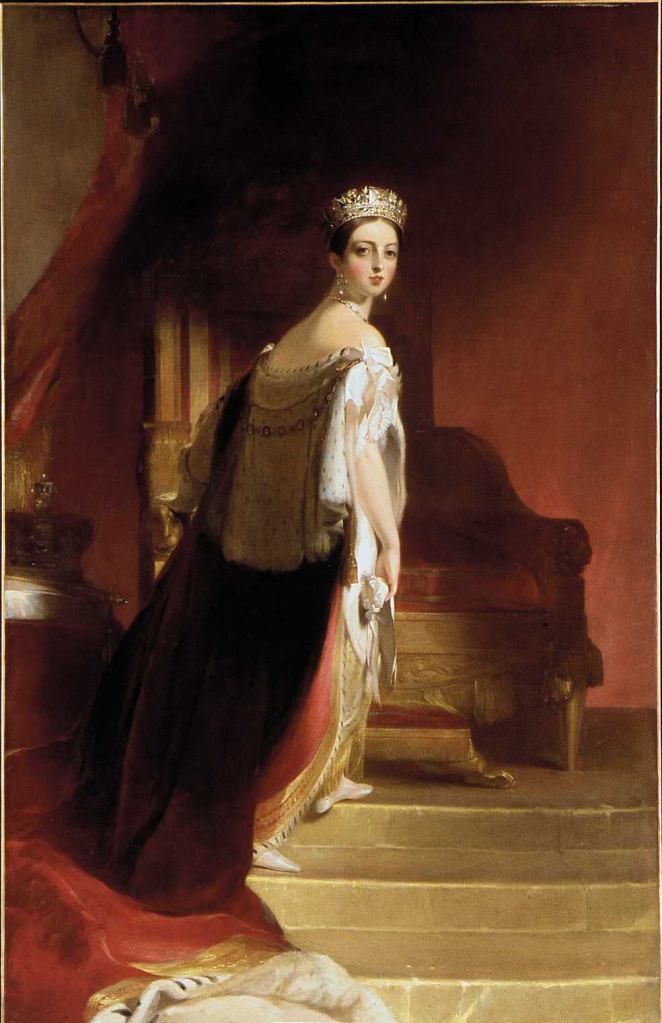
Alexandrina Victoria, on accession to the throne.
She married the next year, and said this of her husband:
I NEVER, NEVER spent such an evening!!! MY DEAREST DEAREST DEAR Albert … his excessive love & affection gave me feelings of heavenly love & happiness I never could have hoped to have felt before! He clasped me in his arms, & we kissed each other again & again! His beauty, his sweetness & gentleness—really how can I ever be thankful enough to have such a Husband! … to be called by names of tenderness, I have never yet heard used to me before—was bliss beyond belief! Oh! This was the happiest day of my life!

1843 portrait, Age 24.
Lytton Strachey wrote a biography of Victoria, which came out in 1921. He described how things were done toward the end of Albert’s life, after twenty years of marriage.
Basically, she left the problems of government to her husband.
The weak-willed youth [Albert] who took no interest in polities and never read a newspaper had grown into a man of unbending determination whose tireless energies were incessantly concentrated upon the laborious business of government and the highest questions of State. He was busy now from morning till night. In the winter, before the dawn, he was to be seen, seated at his writing-table, working by the light of the green reading—lamp which he had brought over with him from Germany, and the construction of which he had much improved by an ingenious device. Victoria was early too, but she was not so early as Albert; and when, in the chill darkness, she took her seat at her own writing-table, placed side by side with his, she invariably found upon it a neat pile of papers arranged for her inspection and her signature. The day, thus begun, continued in unremitting industry. At breakfast, the newspapers—the once hated newspapers—made their appearance, and the Prince, absorbed in their perusal, would answer no questions, or, if an article struck him, would read it aloud. After, that there were ministers and secretaries to interview; there was a vast correspondence to be carried on; there were numerous memoranda to be made. Victoria, treasuring every word, preserving every letter, was all breathless attention and eager obedience. Sometimes Albert would actually ask her advice. He [German] consulted her about his English: “Lese recht aufmerksam, und sage wenn irgend ein Fehler ist,”[“Read this carefully, and tell me if there are any mistakes in it.”] he would say; or, as he handed her a draft for her signature, he would observe, “Ich hab’ Dir hier ein Draft gemacht, lese es mal! Ich dachte es ware recht so.”[“Here is a draft I have made for you. Read it. I should think this would do.”] Thus the diligent, scrupulous, absorbing hours passed by. Fewer and fewer grew the moments of recreation and of exercise. The demands of society were narrowed down to the smallest limits, and even then but grudgingly attended to. It was no longer a mere pleasure, it was a positive necessity, to go to bed as early as possible in order to be up and at work on the morrow betimes.

Albert, Victoria, and their nine children, 1857 (Age 38).
Albert looks ten years older here, but actually he was a couple months younger.
Albert died in 1861, Age 42.
Note that everyone is dressed in clothing then typical of the Upper Middle Class, not royalty.
The important and exacting business of government, which became at last the dominating preoccupation in Albert’s mind, still left unimpaired his old tastes and interests; he remained devoted to art, to science, to philosophy, and a multitude of subsidiary activities showed how his energies increased as the demands upon them grew. For whenever duty called, the Prince was all alertness. With indefatigable perseverance he opened museums, laid the foundation stones of hospitals, made speeches to the Royal Agricultural Society, and attended meetings of the British Association. The National Gallery particularly interested him: he drew up careful regulations for the arrangement of the pictures according to schools; and he attempted—though in vain—to have the whole collection transported to South Kensington. Feodora, now the Princess Hohenlohe, after a visit to England, expressed in a letter to Victoria her admiration of Albert both as a private and a public character. Nor did she rely only on her own opinion. “I must just copy out,” she said, “what Mr. Klumpp wrote to me some little time ago, and which is quite true—’Prince Albert is one of the few Royal personages who can sacrifice to any principle (as soon as it has become evident to them to be good and noble) all those notions (or sentiments) to which others, owing to their narrow-mindedness, or to the prejudices of their rank, are so thoroughly inclined strongly to cling.’ There is something so truly religious in this,” the Princess added, “as well as humane and just, most soothing to my feelings which are so often hurt and disturbed by what I hear and see.”
Victoria, from the depth of her heart, subscribed to all the eulogies of Feodora and Mr. Klumpp. She only found that they were insufficient. As she watched her beloved Albert, after toiling with state documents and public functions, devoting every spare moment of his time to domestic duties, to artistic appreciation, and to intellectual improvements; as she listened to him cracking his jokes at the luncheon table, or playing Mendelssohn on the organ, or pointing out the merits of Sir Edwin Landseer’s pictures; as she followed him round while he gave instructions about the breeding of cattle, or decided that the Gainsboroughs must be hung higher up so that the Winterhalters might be properly seen—she felt perfectly certain that no other wife had ever had such a husband.
Her devotion to husband and family, played out on the world stage, became the model that all of British society imitated. The degeneracy of the 18th century faded; and the Victorian Age remains not only an example of moral discipline and strong family values compared to the twentieth century, but also, to all previous British history.
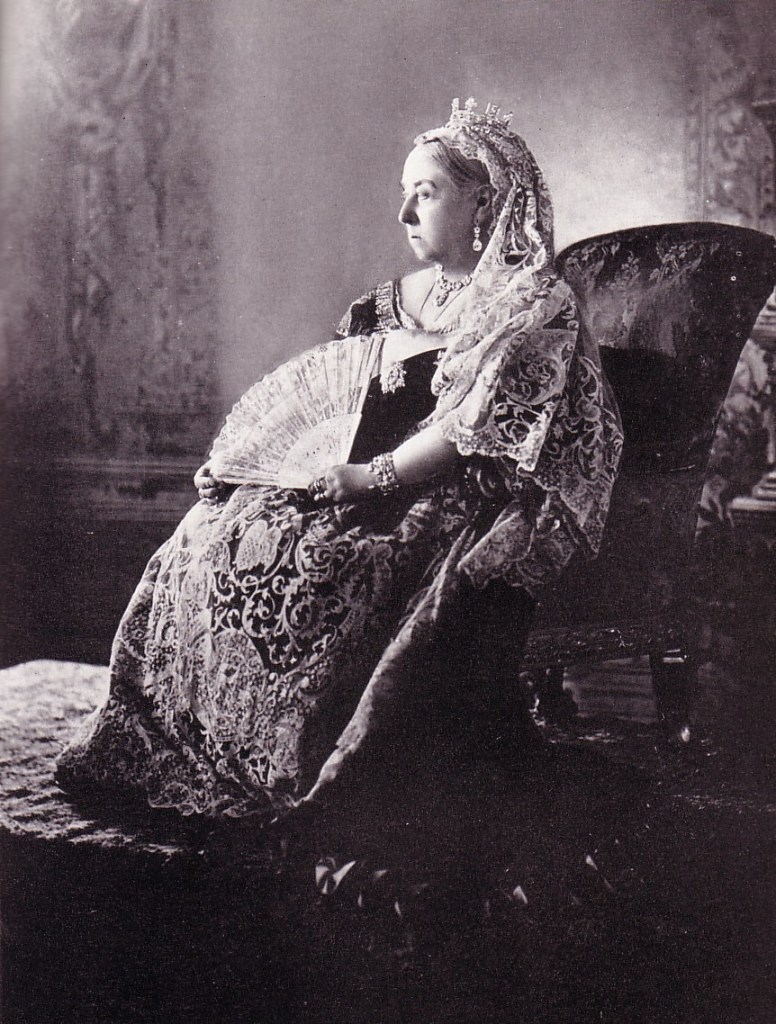
Diamond Jubilee portrait, 1897. (Age 78)
With wives like these, it is no surprise that British men kicked the whole world’s ass, whether in industry and commerce; science, letters and learning; or warfare.
Among these men were her own husband, who, with Victoria’s support and encouragement, went from being a floppy youth with typical rich-kid vices, to an exemplar of masculine expertise, industry and leadership.
This is how Queen Victoria became, as measured by the success of her country during her rule, one of the greatest national leaders of all time.
 Cornerstone