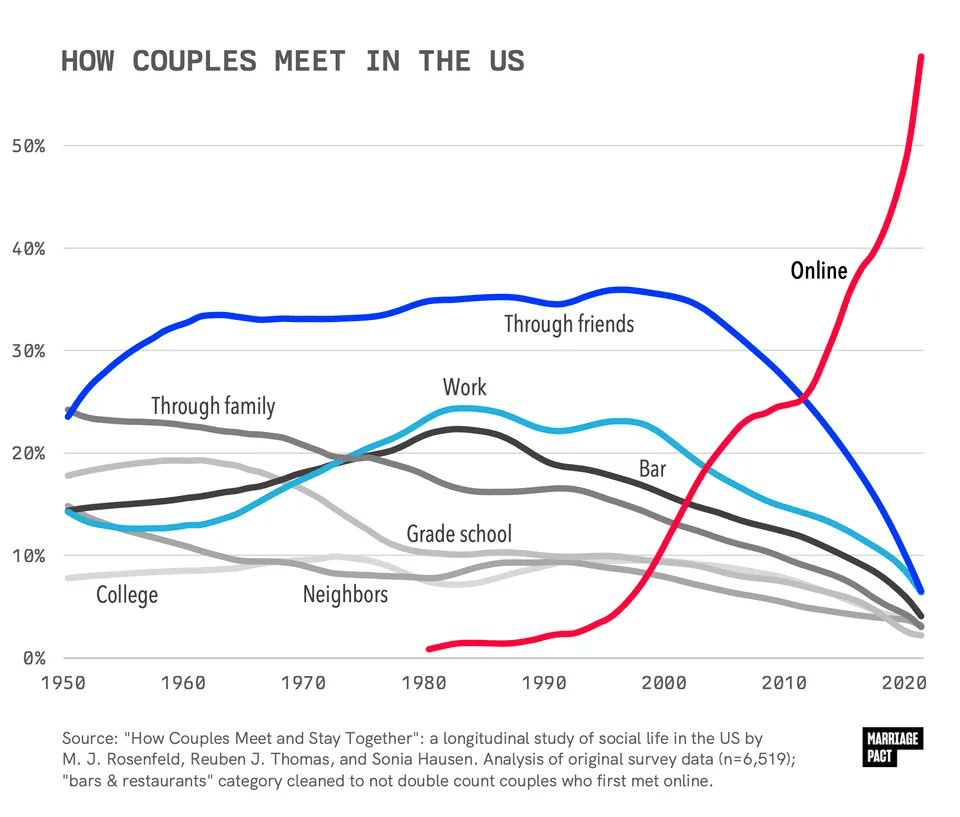
But, one result of this, is that people act in real life as if they are online. For men, this means: 80% assume they are “out of the game.” For women: their “standards” reflect their online swiping habits, or the Top 5% (or 1%) of men; and all the consequences that follow from that. 5% of the men can’t marry, or have a monogamous relationship, with 80% of the women.
Pearl Davis smacked around tradcon Michael Knowles recently, brilliantly illustrating all the things that Dalrock explained 10 years ago:
tl;dr
Around here, we have old barns that sometimes don’t make it through the winter.
This is, on one hand, a tragic loss of tradition and beauty.
But, if you went into that barn, in the year before it collapsed, you would find that none of it was salvageable. The wood was rotten and crooked. Any concrete foundations were cracked and crumbling. The roof was crumbling (if asphalt) or rusting (if metal). Basically, it was the same as the barn on the right, that is still standing, for now. There was literally nothing to save, which is why the owner didn’t try to save it. If you tried to replace everything that needed replacing, you would literally be building a new barn. So, just let it collapse. Often, the way that a collapsed barn is disposed of is: lighting it on fire.
Marriage and family, before the recent collapse in marriage and childbearing rates, was like that barn the year before it collapsed. There was nothing of the old barn that was structurally sound. You couldn’t even get around to building a new barn, until the old one had collapsed.
Conservatives want the old barn, the one that was just about to fall apart.
You can build a new barn, much like the way that barn was built, when it was new, a hundred and fifty years ago.
For example, it was only a few years ago that about 92% of both White Men and Women eventually married. But, this was often a disaster.
Going forward, it might be a lot less than this. Maybe less than 50%.
But, let’s not be too picky. Let’s just apply some basic minimum standards. Let’s say that a man should not marry a woman who:
Is over 40.
Is a single mom (never married).
Is divorced.
Is a confirmed slut (let’s say, the worst 20%, which gives a lot of room for women who actually wanted a relationship but ended up in side chick rotation.)
Has a sexually transmitted disease.
Is a feminist nutjob; whines about “patriarchy,” claims that a stay-at-home wife is a “slave,” etc.
Has blue hair, excessive tattoos, snot rings, autistic, handicapped, diseases, alcoholic, drug addict, addicted to prescription brain meds, etc.
Is a lesbian, “polyamory” fan, extra good friends with her dog, pole dancer, OF girl, etc.
We will also say that: Ugly women should be left to equally ugly men. In other words, if you are not in the Bottom 40% of Ugly men, then forget about the Bottom 40% of Ugly women, which basically means: fatties.
Since about 25% of White women end up as unmarried Single Moms, and about 50% of the remainder (50% of 75% or 38%) as divorcees, that alone eliminates almost 50% of all women. 20% are sluts (lots of overlap here), about 25% have STDs, and about 25% are, let’s say, unrecoverable Leftist feminist freaks. Then, we drop the 40% of Fuglies. We didn’t even have a line for debt, which is certainly a big penalty. How is a man supposed to take on $100K of a woman’s debt?
This is not a very demanding set of standards. Much of it (single moms, divorcees) is right in line with Biblical guidelines. But, we can see that if we apply just a few basic screens, which I think we have to do, we quickly screen out 50% or more of single women.
I’ve said that we should aim for the Top 30% of women. Mostly, try to get them young, Age 16-18, which is what you have to do to marry around age 18-20, with the stragglers done by Age 25. We will have to provide a viable and actionable alternative to going to college, which means before Age 18. A lot of women are actually not too bad at this age. No debt. No tattoos. Many virgins. No single moms.
This is what a Marriage and Family strategy should look like.
Rather than focusing on all the not-so-good girls, we should focus on those girls that, I think, would be in the Top 30% or, at the very least, the Top 50% of women. There are actually a lot of them out there and they are not too bad.
I think this girl is pretty funny. She is very mopey and that is probably not someone you should get involved with. Nevertheless, I think her “I’m such a loser” routine is strangely attractive. It is the polar opposite of the posturing girlboss. I think she could make a good wife and mother, in a modest, middle-class sort of way. She passes all of our tests above. She could marry an auto mechanic, or a house painter, stay at home, learn to cook, and raise some decent children.
Then there is this woman, “Adrianne,” who seems very nice and available (although she says she has a boyfriend). She’s a strong 8/10 — maybe even a real-life 10/10 if you adjust for digital filters — and did some modeling when younger. She doesn’t like “TradWives” much, but since 90% of young women today have some Leftist-Feminist brainwashing, including regular churchgoers, this is something you would have to deal with.
Maybe, like Domestic Extremist “Peachy Keenan,” she could get over it.
Of course we would all like Conservative Virgin girls who are also 10/10.
But, these women are rare, and they deserve husbands who are as virtuous and good looking as they are.
— Bow_BaNkErS | Meme Mercenary (@BowTiedBaNkErS) June 28, 2022
Undeserved Villain Rap:
Cal
– Pays for Rose and and her moms passage on the Titanic – Knew Rose’s family was on the brink of poverty and did her a favor by marrying her – Gifted Rose a $350 million dollar necklace – Never cheated on Rose. Meanwhile she was banging Jack in a… pic.twitter.com/sH7UeLJBsx
How many Hollywood movies have been basically training young women to chase Bad Boys? Aladdin is not just lower class, he is literally a street criminal. Princess Jasmine has her pick of a wide range of suitors, including literal Prince Charmings, and refuses them all. And what is a “Magic Carpet”? Crack cocaine?
Myron Gains, of the “Fresh and Fit” Youtube channel, is another among the secular philosophers, originally of the “PUA” flavor, that ended up more reactionary than 90% of practicing Christians.
What every young woman needs to hear:
Preserve your virginity until marriage or at least until you meet your future husband.
Enroll in sports and musical instruments in school to develop character, discipline and a unique skill set.
Humans are not historically centered around the nuclear family. They have and are adapted for family as in kin, tribe, and extended family.
In nature, we have pairbonder species and tournament species.
Pairbonder species involve a male and female, alone in their territory together, perhaps with offspring.
This is decidedly NOT the human dynamic, until the wealth and opportunity of cities combined with rapid transportation and eventually discreete messaging obliterated that.
Since the 1950s especially, we’ve seen the rise of nuclear families, and the expression en masse of pairbonder men.
The problem with pairbonder men is that they are usually controlled by the women, do not build or defend good territory, and in focus all their efforts into the low return tasks of provisioning women and heavy investment into parenting.
A mans value is in building and providing the territory. @Meta_Trav has laid this out masterfully. A well designed territory contains:
The wordspace and rule set
The congregation point
male fraternity
female sisterhood
council that provides moral authority and accountability
How many men are providing territory like this that their wife, children, or community are benefiting from?
Almost zero.
Notice also, that no man can do this by himself. A one person council is a dictatorship.
It requires adult cooperation between men, and their leadership to create cohesive, safe, high stimulation territory.
Territory is not something you “fight over”. It’s built, designed, and engineered. This can be achieved only with mature, adult cooperation.
That said, there will always be those with spite that wish to disrupt, harm, or take over your territory. Rights and benefits exist insofar as you can secure them, and as such defending territory is a key imperative and major reason men form coalitions/packs/fraternity.
Modern mainstream thinking is that thriving families are built by a man investing in a woman and his children alone in the pair territory.
Couldn’t be less true. No one thrives in a house by themselves, a lone wolf, as the large fraction of people live today.
What does work is building territory with other men that affords for, and insures, the cooperation of men in providing: a cohesive, stabilizing rule set; safe haven; congregation point; fraternity for men; sisterhood for women; and plenty of stimulation.
This is a territory in which men, women, and children are able to thrive because they have the love, support, resources, care, and protection of a cohesive territory and community.
Development happens naturally because women and children have all the correct incentives, lots of healthy stimulation, and support to thrive and grow.
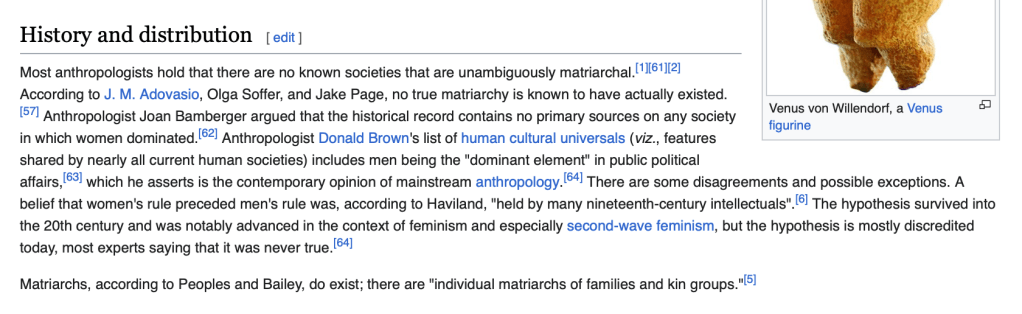
Anthropologists say that they can’t find any evidence of any Matriarchal society, at any time or place, among primitives, and certainly not among advanced civilizations. We only have Strong Patriarchy, or Weak Patriarchy.
Given what we have seen, from experiments like Bear Grylls The Island, or from attempts (spectacularly unsuccessful) at all-woman companies — or the tendency, I hear, for woman pastors anywhere to spend all their time basically arguing that women can do whatever they like with no consequences, and otherwise basically making stuff up out of thin air that suits their mood — this makes sense.
There is a certain, perhaps small, subset of Christian women who are actually pretty happy with using the term Patriarchy.
Because, when you reject Feminism, what’s next for a woman?
I was talking a couple days ago with a man that set up a “Christian Academy” (at least Grades 9-12, maybe 7-12 or K-12). He is also a father of six. In other words, the best sort of person. He was explaining to me that part of this school program is a class on “Chivalry” for boys, and “Christian Womanhood” for girls.
Of course I had a moment of cringe. Dalrock destroyed this “Chivalry” ideal a decade ago.
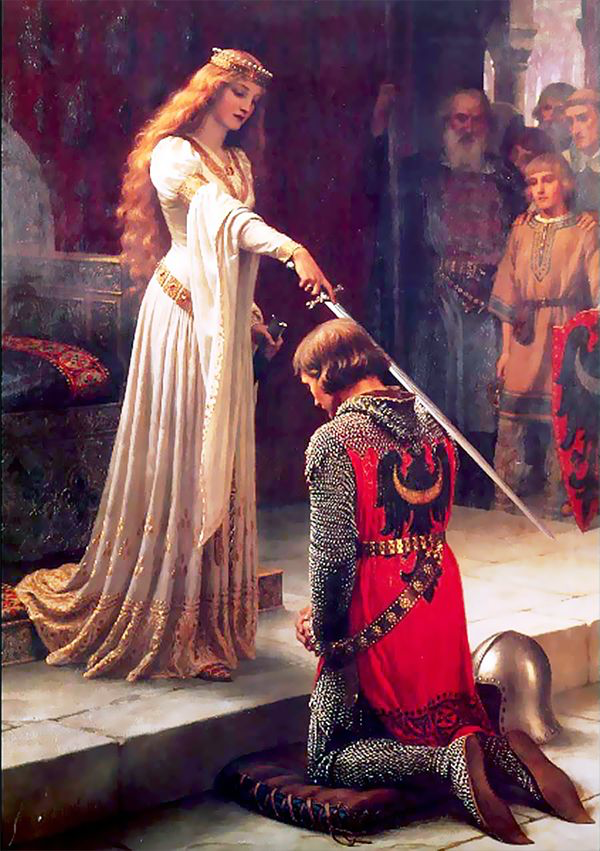
Basically, Chivalry is a pattern of adultery among the noble classes. Typically a married noblewoman, a queen, duchess, etc., would have an affair with one of her servants, probably a Knight in Shining Armor. The basic pattern is that of Arthurian legend, or Queen Guinevere (Arthur’s wife) and Sir Lancelot (one of Arthur’s Knights).
Basically, Guinevere was a Ho, and Lancelot was one of her underlings. This was known as “Courtly Love.”
This ancient theme meshed very nicely with Feminism, with the common element that a man is a servant or underling of a woman, and has to “treat her like a Queen.”
Literally a painting of Guinevere and Lancelot.
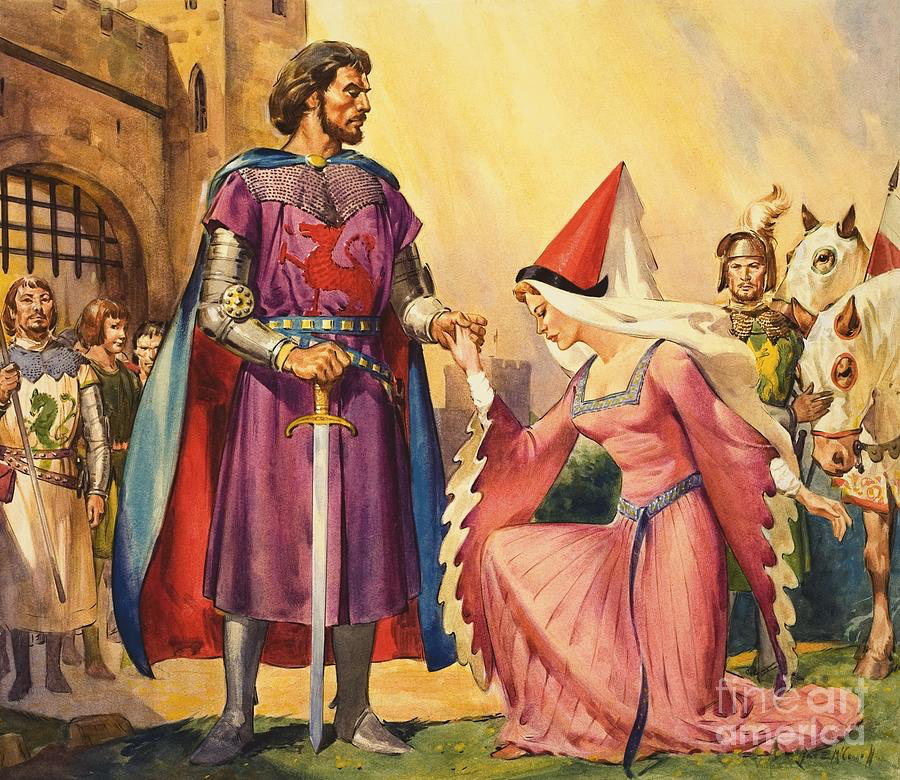
Obviously, we have to discard that pattern. We act like King Arthur, certainly a Patriarch, and what do we do? We take Guinevere, our adulterous wife, tie her to a post, and whip her.
Literally a painting of Arthur and Guinevere.
From Germania (98 AD), by Roman historian Tacitus:
I think that men are still a little hesitant to be Patriarchs. But, that is what we must do. I think women would like it. Be Arthur, not Lancelot.
These days, I think many men assume — usually correctly — that any woman who is divorced, for any claimed reason, blew up her own family for no good reason, and probably destroyed the only man who dared to care for her.
In other words, ladies — if you get divorced, for any claimed reason, you will not get married again.
This assumption is not always right, but it is probably right more than 80% of the time.
Nevertheless, if you are still dumb enough to consider a divorced woman, or worse, a divorced woman with children, then Talk To Her Ex-Husband First, before you get anywhere near (cohabitation) actually marrying this woman.
That will probably solve the problem.
On the other hand, if she really was not primarily at fault, I bet that her ex-husband would tell you so right to your face: “It was my fault, not hers.”
What is a woman to do? In all places and all times, the answer has always been the same: bear children, raise them, and keep house.
This was true of the Vikings of Norway in the 12th century, and equally true in China in the 15th century.
Realistically, a woman should have at least three children, because if population replacement is at 2.1 children per woman, and we accept that some women will fall short of this due to infertility, unmarried, etc., and some children won’t be viable for some reason (disease in the past; maybe autism or other mental disorders today, including rainbow stuff), all women should aim for at least three children, with some failing that goal.
Once you get to three children, that is a handful.
Even when children are out of the house, and a woman enters her Matron era, most of her attention is usually: 1) setting up marriages between her children; or anybody’s children; 2) taking care of grandchildren, directly, or indirectly by supporting her adult children with children of their own; 3) failing that, being active in the community somehow, typically caring for children, as many unmarried older women like to do today, even going so far as adopting children.
This being the case, women intrinsically know how to get the ball moving, between the ages of 16-32, which is basically: to be a Sex Object.
Unfortunately, men today still have a strong aroma of Feminist brainwashing, apparently wishing to deny women’s basic role as a Sex Object.
A woman can be more than a Sex Object. I am happy with brainy (high IQ) and educated women, since this woman, in her role as Wife and Mother, would be primarily responsible for the children’s education, especially if we homeschool (which I do); and later, particularly in the Matron phase, with broader responsibilities in the community and the nation. Plus, good genes: if you want brainy sons, it is best if you marry a brainy woman.
Nevertheless, we men should accept that a young woman’s primary role is to inspire you to take them home (ideally around Age 18-20) and fuck their brains out — getting married first of course, since we are civilized around here — and that we have to arrange things so that men who do so are rewarded for their commitment, rather than punished.
Some of my relations were “mail order brides.” A working man in California chose a woman from a tiny, grainy black and white photograph in a book. She said goodbye to her family for the last time, got on a ship, and met her new husband. I think many women were not all that happy with their husbands. But, they made good wives anyway.
In parts of Ancient Greece, Ionia, there was a bride market. Men bid for the most beautiful women. The bride price was put in a collection and was used for the leftover women. Men who chose a leftover woman would get a wife and also a cash payment.
The point here is: A man could assume, with reasonable confidence, that a woman could serve as an adequate wife and mother. You could literally pick a girl out of a lineup and … within a reasonable doubt, have confidence that you would benefit from this arrangement. The structures of society, legal or religious, would help maintain the family, and the husband’s authority, and the childrens’ wellbeing.
It seems that you can still do this today, in places like the Philippines. A man literally gets off a plane and finds a woman, who doesn’t even speak his language very well. But, she makes a reasonably good wife and mother. The basic requirements of being a Good Wife and a Good Mother are not very demanding. Any woman can do it. It is basically: Do Something Useful (at a minimum, cooking and keeping house); Don’t Make Problems; Keep Your Damn Mouth Shut; Don’t Get Fat; Have Sex Regularly.
Today, there are still some women in the US who make Good Wives and Good Mothers. But, there is a considerable vetting process involved. I have suggested sticking with the Top 30%. 70% of the women today are for the discard bin. Nobody should marry them. Someone will, of course, and they will suffer for their errors. I’ll also admit certain Ugly Women, who would be in my discard bin, but who have tolerably good character anyway, and who would make appropriate mates for equally Ugly Men. Mostly, this means: obesity.
Probably, out of those 70% of discard-bin women, about 40% would probably be OK, IF they were put in a stringent environment where bad behavior was punished. The Bottom 30% are, let’s say, unfixable. Jim (of Jim’s Blog) has talked about this. But, until we have that stringent environment, whatever it may entail — probably, new laws and the support of a Church — these women cannot be trusted.









 Cornerstone