I have only ever known one woman who was the Total Package: 9/10 for looks; 10/10 for brains; and 9/10 (I think) for character. She married a friend of mine.
She went to Japan’s top university, Tokyo University. Tokyo University is sort of like Harvard, if Harvard was competitive. But, Tokyo University is also free to all students, if you can get in. No debt. Also, women don’t feel the need to have a career, to justify the huge expenses of education. They can be well-educated stay-at-home Moms.
She also lived at home, with her parents, until marriage. Now, still married to my friend, she is a stay-at-home mother of two.
In the past, daughters lived at their father’s house until marriage. This did not take long — these girls were typically married around Age 18-20, ideally, and practically, before Age 25. While today’s young women are playing the role of college degenerates, women Age 18-20 in the past were starting big adult responsibilities, of creating a new home and, soon after, filling it with children.
Staying at home was not the goal of a stay-at-home daughter. Rather, it was to get married and start your own household.
During their time at their Father’s house, they often helped raise their younger siblings. There was plenty of housework to do in those days, when it was common for women to make all the clothes, and even, to spin thread and weave cloth. Gardens and food preservation took constant effort.
In the houses of the wealthier, daughters often had private tutors. They were better educated than women today who go to college, but gain nothing but Marxist brainwashing.
In the houses of the less-wealthy, daughters often helped the family financially by becoming schoolteachers, or serving as private tutors.
Recreation of the schoolhouse where Laura Ingalls, author of the Little House on the Prairie books, had her first job as a schoolteacher in 1883, at Age 16.
Recently, there has been a movement toward stay-at-home daughters. Here is the trailer for a recent documentary on stay-at-home daughters, The Return of the Daughters.
westernconservatory.com
It’s the way things were done in the West for many centuries, and it worked. It’s the way things were done in the East too. Needless to say, a lot of Christians didn’t like this idea much.
More young women, or girls, these days are getting the idea that maybe they don’t want to go to college/get a career — even while their parents are pressuring them in that direction. College basically consists of vocational training, and general education. You don’t need vocational training, since you aren’t going to have a job. And, there isn’t much good general education (“Liberal Arts”) going on in universities these days, even Harvard and Yale. Mostly, it is Marxist brainwashing.
I think that women should actually get a general education, in important principles. You would be better off just studying on your own. Read books likeThe Making of America or The Patriot’s History of the United States. If you decide that you do want vocational training, for a womanly occupation of some sort that you can drop after you get married, just do that and skip the rest.
In the past, young women were often schoolteachers, or nurses. It might seem like women didn’t have a lot of occupational options in those days. But, since these women were soon getting married and quitting their jobs in a couple years, there was huge turnover in schoolteachers and nurses. It was enough to employ all the women who wanted jobs, in those days.
Many young women have privately messaged me who no longer want to pursue the career path. They want to learn homemaking skills instead, so they’ll be prepared for marriage and children. Yet, their parents want them to continue on the career path racking up a ton of debt. What should they do? … She needs to tell them that all she wants is to be a wife, mother, and homemaker. If they tell her she must be prepared for the “what ifs…” then she tells them that she will find ways to make money that involve nurturing and doesn’t require a long, expensive education. Plus, if she gets a good career, she may be stuck in it forever since her future husband may value the money she makes over having his wife raise their children. Many women make more money than their husbands these days, and this is NOT good nor healthy for a marriage. Men are called to be the providers, not women.
This is good advice, but a young woman should not “study homemaking skills” instead of “studying career skills.” Homemaking skills are easy. It can take many years to learn how to cook well, but you have many years, so don’t worry about it. What a young woman needs is to find a husband and get married young. Around age 18-20 is the goal. It might take a little longer, but absolutely get it done by Age 25. Besides, God gives you itchy panties so that you will make some babies. I suggest that you follow God’s Plan — after getting married, of course.
Back when Elizabeth Warren was doing something useful, instead of being a Socialist pest, she wrote a book called The Two Income Trap. It was an investigation into how families ended up in bankruptcy.
Warren found that families were not, for the most part, spending money haphazardly or wantonly, on silly luxuries. Rather, their fixed expenses, especially housing, healthcare, and education (including daycare), chewed up all their income, before they even got a chance to squander it on silly stuff. Families were being pushed toward two incomes (working mothers) to pay for all this, and they were still barely able to pay the bills. But, with two working parents, if either of them lost their job, they were on their way to bankruptcy. Thus, it was actually twice as risky to have two working parents, than having one. This was true even of better-off middle-class families, often with a gross income in excess of $100,000 per year.
Around here, I promote the principle of the stay-at-home Mom, preferably one who homeschools. Warren found that one of the biggest things pushing families into bankruptcy was competition to get into the better school districts; which, in the United States, typically meant having to buy a big house. If we use the idea of a house that is 3x income, then even if a family has $200,000 of income, they would be stretched to the limit with a $600,000 home, which is not uncommon these days. Plus, that second income (the working mother) comes with a lot of extra expenses, including daycare, a second car, a lot of take-out food, and other afterschool activities to keep the children busy while Mom is working, or needs a break.
A family that wants to have a Stay-at-Home Mom is going to have to get by on a lot less income. You are going to have to take the load off. I have suggested that a young family look for much cheaper housing, than the typical single-family house. Probably, this means a one or two-bedroom condo. With a one-bedroom, you could probably split it up into two small bedrooms, without too much difficulty (you can do this when you own the condo).
Miami is not the cheapest city in the U.S. But, you can live in a two-bedroom condo in Miami, pretty comfortably. Here is a two-bedroom condo for sale today for $135,000.
There’s a nice interior courtyard with a pool, and also you are on the water. That is bigger than any suburban backyard. And — you don’t have to take care of it! Someone else mows the lawn and cleans the pool. Do something fun on the weekend.
It is a little bit older building, and a little dingy. But, it would clean up nicely.
Good enough.
The total housing costs are estimated at $1,112 a month. Remember, if you have a single-family home, you are going to have to do a lot of repairs and maintenance too. Those roof replacements, regular painting or heater replacements can easily come to $5000/year.
And, it is only $135,000. If you managed to pay off an extra $1000 a month of principal on the mortgage, you would be done in less than ten years.
You should think of 2x income as a good measure for housing costs, or less than this. 3x is “the limit,” but you don’t want to push things to the limit. So, you could afford a place like this with a $70,000 income from one working parent. The neighborhood looks decent enough. You should try to live in a good neighborhood. I would pay more per square foot/get a smaller place, in a better neighborhood.
Warren found that the main motivation pushing parents to buy too much house was an attempt to get into the better school districts. One reason for this is because parents were entirely dependent on the public schools. Since they work all day, they would have little time with their children.
We can skip all this by homeschooling. We still want to live in a better sort of neighborhood, but we don’t care about the schools. Today, even the best public schools are pretty dubious.
Besides housing and education, the big expense for many families is healthcare. Healthcare in the US is a disaster. In other countries, free-market healthcare is very effective and cheap — about half the price of “socialized” healthcare systems. Singapore, for example, with its free-market healthcare system, spends only about 5% of GDP on healthcare, compared to 10% in France and 18% in the U.S. But, Singapore (which is wealthier than the US) is considered to have one of the best healthcare systems in the world.
Today in the U.S., a new “free market” healthcare system is beginning to peek through the cracks. This includes the recent spread of “urgent care” clinics, where you can walk in with no insurance. You get 20-30 minutes with a doctor/nurse practitioner, with some tests, diagnosis and prescriptions if necessary, and you are back out the door only $80 poorer. This is not a copay, it is the full price. Recently, providers have been moving toward “online” solutions (basically, video like Zoom or Skype with a doctor). This is even cheaper: Here is one provider that charges $49 a “visit” (with no other insurance). Modern medicine is largely drugs and surgery. 90% of all drug prescriptions these days are for generics; and probably, some of the remaining 10% could be filled by generics too. Just insist that your doctor only give prescriptions for generic drugs. Then, go to GoodRx to find the cheapest prices. Often, the best prices are much, much, much lower than you might find elsewhere. Generic drugs generally don’t cost much more than Tylenol. Most of the cost actually goes to the pharmacist who fills the prescription. Usually, there is no reason to spend more than $100 a month or so on any drugs. Lipitor (Atorvastatin) is a common pill for heart issues. You can get it for $4.95 for 30 tablets.
For more serious surgery, “medical tourism” is a good solution. Whether it is a US hospital such as the Surgery Center of Oklahoma, or a hospital catering to foreigners in Mexico or Costa Rica (or Singapore), you can get top quality care for prices sometimes one-eighth of what US hospitals charge. As an American citizen without insurance, you can get on a plane and get a heart bypass surgery done in Singapore for about $25,000, compared to $135,000 in the U.S. If you go to Thailand (which has very nice hospitals), it’s more like $18,000. At Tan Tock Seng hospital in Singapore, you can get an appendectomy done for $1,727. Just show up with your Amex card. I heard of one man who had cancer treatments in Thailand over the course of a whole year. A whole year of cancer care, plus all living expenses for a year, cost him a total of $30,000. I bet he had a good time too. Another option is “concierge services,” which means: a private doctor who charges a small fixed price per month for healthcare services. It is usually pretty cheap, around $200 per month.
The point is: a young family today, especially one that aspires to have a Stay-at-Home Mom, needs to get their expenses way, way down. You can’t follow the example of typical families today that can’t get by even with two incomes. Read The Two-Income Trap for a good example of What Not To Do.
You can still have nice things, too. Actually, it doesn’t take many nice things to fill up a 900 square foot condo. $2000 spent at an antique store, or buying used quality furniture on Craigslist, would about do it. Nice things are very cheap these days, especially on the used market. Every day, Boomers are retiring or dying, and all the nice things they accumulated over a lifetime are sold. Too many people live like slobs, when there is really no good reason for this. Get a beautiful dining table, or bedroom set. Having a nice home, and all the work that is involved in achieving that, is one of the principal duties of the Stay-at-Home Mom.
You can wear nice clothes without being a sexpot all the time. Here are two Twitter feeds that look at classic fashion.
One is B of Beauty (@bof_beauty). Actually, a lot of these are very sexy, but in a high-end sort of way. If you want to be a Trophy Wife, not a Side Chick, do it like this.
The other is Our World (@oloiux):
This has some new pictures of new clothes that are not part of any historical period, but wouldn’t have been out of place in 1910.
This is very modest “covered up below the neck” look, but very beautiful!
If you want to meet Prince Charming, it helps to dress like Princess Charming.
Women wonder why men are not romantic anymore.
When a man goes looking for “the mother of his children,” he is looking for something like this.
You don’t have to wear jeans and t-shirts every day.
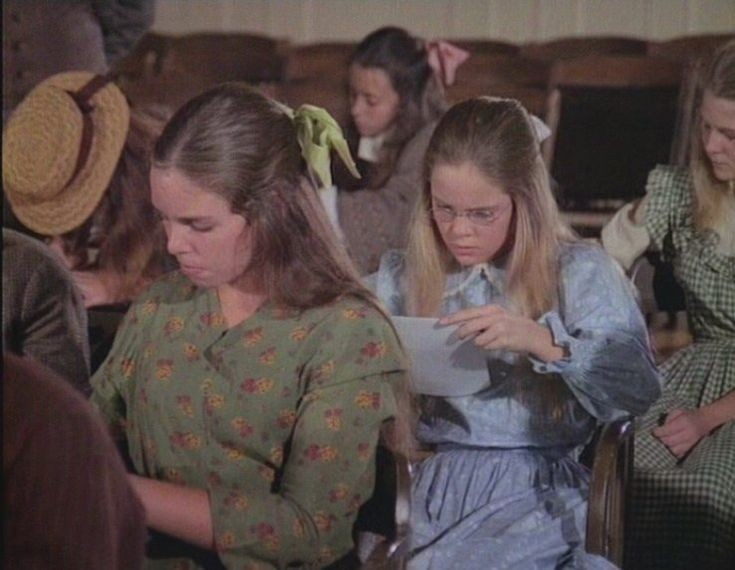
A still from the TV show Little House on the Prairie, showing a one-room schoolhouse in the Dakota Territory, during the 1880s.
Here is a picture for a collection of books by Eleanor Porter, including the famous Pollyanna.
Don’t these seem like the most splendid girls? I wish girls would dress like this again. Since girls don’t have any money, this also depends on their mothers, to get them some nice clothes.
One of the advantages of Courtship, or Courtship that involved “dating,” (that is, without sex), aka “Traditional Dating,” was that a man and a woman would spend a lot of time together, without having sex. They would find out if they enjoyed each other’s company. They would become friends first. Somewhere along the line, they might also “fall in love.” Unfortunately, a lot of marriages today are among worn-out Carousel Riders and their simp-y Beta Provider husbands, where “falling in love” (aka “pair bonding”) is nowhere to be found (among the women), and where women not only don’t like their husbands very much, but actually dislike them.
“Dating without sex” doesn’t make much sense in terms of “dating,” which is why one rule among “daters” is: “If she doesn’t put out in three dates, dump her. She is not that into you.” But, in terms of Courtship, it is no big deal: If you are going to get married anyway, who cares if you end up waiting three months or so, especially if you enjoy the company if this woman, as a companion, without sex? It would just be adding something good to something good.
This imbalance in the sexual marketplace is not a good thing. A society teeming with lonely women and sexually frustrated men is one hurtling toward disaster. It is imperative that we, as a society, think carefully about solutions to this burgeoning crisis.
This is systems thinking. Apparently, only men can do it.
“The hand that rocks the cradle rules the world,” it has been said. This is not quite so: but the “hand that rocks the cradle” does determine the world. It seems like the oddities of young people are rather irrelevant. Who cares if some 19-year-old dingbat has some kind of kooky opinion in college? It seems like they don’t have much influence. Their elders and betters both outnumber these young goofs, but also, have positions of responsibility and leadership. But, these young people eventually grow up; and those elders, raised under different conditions, get old and die. The young goofs become degenerate adults, entering and then eventually leading the major institutions, and the older adults become irrelevant.
Unfortunately, women today have largely abandoned the task of raising children (and thus “determining the world”) to public schools, television, media, universities, and basically the whole Cultural Marxist sewer pipe. We really don’t need women to do men’s jobs. What we need is someone to raise the children so that they don’t grow up to be the modern-day equivalent of Mao’s Cultural Revolutionaries. This will, at the least, require getting the children out of public schools; and much more than that. Men need to find wives who are ready and able to do that, and who are not themselves irredeemable products of Cultural Marxist pollution. In other words, a TradBabe of at least Level 4 housewife potential.
Here, as inspiration, is the original 19th century poem, “The Hand That Rocks The Cradle Rules The World.”
The Hand That Rocks the Cradle Rules the World by William Ross Wallace (1819-1881)
Blessings on the hand of women! Angels guard its strength and grace. In the palace, cottage, hovel, Oh, no matter where the place; Would that never storms assailed it, Rainbows ever gently curled, For the hand that rocks the cradle Is the hand that rules the world.
Infancy’s the tender fountain, Power may with beauty flow, Mothers first to guide the streamlets, From them souls unresting grow — Grow on for the good or evil, Sunshine streamed or evil hurled, For the hand that rocks the cradle Is the hand that rules the world.
Woman, how divine your mission, Here upon our natal sod; Keep – oh, keep the young heart open Always to the breath of God! All true trophies of the ages Are from mother-love impearled, For the hand that rocks the cradle Is the hand that rules the world.
Blessings on the hand of women! Fathers, sons, and daughters cry, And the sacred song is mingled With the worship in the sky — Mingles where no tempest darkens, Rainbows evermore are hurled; For the hand that rocks the cradle Is the hand that rules the world.