For most people, unless you are from the kind of family that takes two-week vacations in Italy, it is best if you have a modest wedding.
I would find a nice but inexpensive venue, perhaps at a State Park or a Beach. In a pinch, you could use your parents’ backyard. Or, get married in a church. For a reception, keep it to about 20 people, including your nuclear families, and five friends from each side. Have your Mom and Sister make the food. You can have a good time with 20 people for about $1000 if you make an effort. Tell the guests to bring a case of wine as a wedding present. Something you can really use.
One advantage of a modest wedding is that you will weed out all the women with Princess Wedding fantasies. Besides being able to put the money toward a down payment on a house, you’ll have the kind of wife that will let you pay off the rest of the mortgage decades ahead of time. Maybe have a Big Honeymoon instead of a Big Wedding. Hardly anybody takes a whole month off anymore.
Brittany Sellner made a recent video about big weddings. But, perhaps more interesting were the comments on the video, which included many young couples that were thinking of eloping (getting married in secret) simply to avoid the pressures, difficulty and expense of a wedding! Weddings are supposed to be fun.
I don’t have daughters, but I often think about what I would do if I did. I would want them to wear pretty, girly clothes, that don’t make them look like hoebags in training. This is not so easy these days. (I suggest below-the-knee lengths only.) Hayden Girls (haydengirls.com) is a company that makes nice clothing for girls.
It’s not even very expensive. Moms, get your girls some nice clothes.
Earlier, we had examples of TradBabes subcategory: BigBrain, which includes Helen Roy and Rebecca from Blonde in the Belly of the Beast. Today, we will have an example of the TradBabe subcategory: Fashion Plate. Because, we need more than just BigBrain girls, we also need those who represent the full spectrum of civilizational accomplishments, of the feminine sort.
Today, we have Amorette Locke (I assume that’s her name), or @amorettelocke on Twitter.
She is not only a 10/10 girl, but competitive on the world-class level. This is like the difference between a woman that has run a marathon and a woman who is on the podium at major races. Plus, she is a Christian, a homeschool-aspirant and supports the repeal of the 19th Amendment. And a dancer and a pianist. Not an everyday sort of girl.
OK, let’s take a look:
This is exquisite, but it is not very sexy. OK, it is very sexy, but it is not supposed to be very sexy. Not slutty, in other words.
While this is as rare as a Snow Leopard these days, in the past, there were a lot of upper-middle and upper-class girls who were Fashion Plates.
Go ahead and Be a Fashion Plate, if you feel that is your calling.
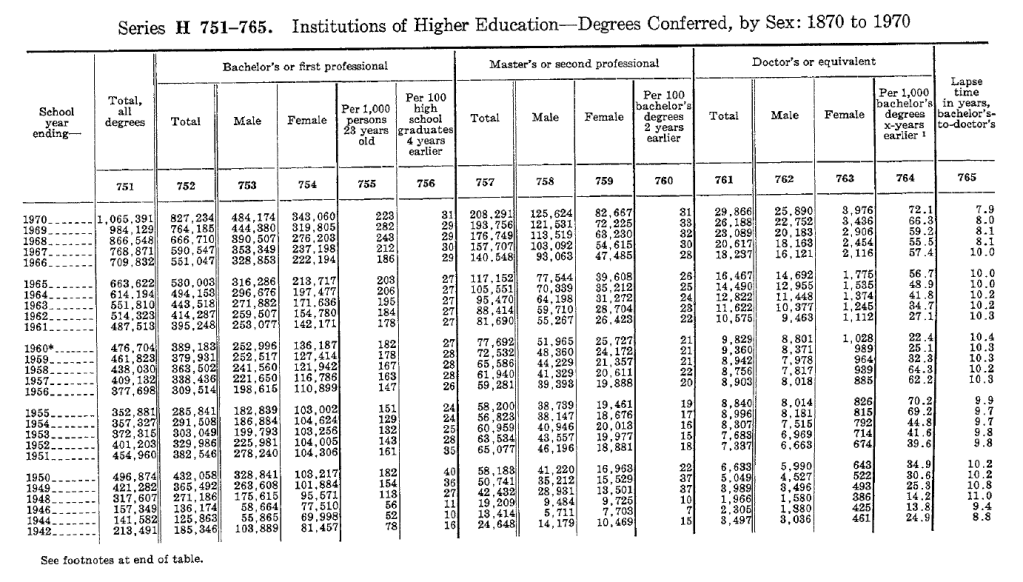
In the past, before 1970, I think it is safe to say that the primary reason women went to college was to find a husband.
At a college, you would find a lot of young men likely destined for upper-middle class professions. They were single, horny, and free of parental supervision. Also, men often outnumbered women 2:1. The result was that a lot of women who went to college ended up marrying one of these men, either while she was a student or soon afterwards. It was common for women to quit school once they got married. This makes more sense if we consider that it was common for a woman to get married to a man a year or two older; and those men, after graduating, soon moved to a new city. These young wives had to leave school.
Even in 1880, women received about 20% of all university degrees. This did not even count the women who got married and dropped out. Women who went to college enjoyed a 4:1 sex ratio advantage. I bet a lot of them got married.
From the perspective of the man, a woman at college was likely from a well-to-do family. She had the discipline to finish all the prerequisites for college, namely high school, which was rare in those days, and also, compared to today, quite difficult. Some knowledge of Latin and Greek was considered a prerequisite of college. She was also learning something at the college itself. The cost of college wasn’t so high in those days, and women didn’t have debt. They did not have to get a career to justify the huge cost of college to their families. This sort of woman could be expected to be the kind of wife that would insist on great things for her children, and work to achieve them. It would be hard for a man to find this kind of woman outside of a college, especially since most of them were soon married.
Already by 1965, the percentage of degrees given to women was 40% — this again omitting those women who dropped out after getting married. These women were not planning of having careers. They wanted to find a top-quality husband. It was common for men to seek the kind of woman who had a college degree. This still probably meant that she was from a better sort of family, and was both educated — really educated, in those days, not just credentialed — and had good self-discipline. She would make a good wife for the kind of man that has high aspirations for his own children.
Today, women are told that their college boyfriends are transient and replaceable. They can be tossed aside after graduation, as a woman moves to a new city for a new career. Getting married to your college sweetheart is now actively avoided and condemned. Men are avoiding women altogether lest they be accused of “sexual assault.” College-educated women tend to be careerist sluts — “sluts” being the natural result of eight years of high school and college where it is assumed from the start that all relationships are transient and disposable — who are also full of feminist brainwashing horseshit, make bad wives, and have too much debt. They are already Married to the Corporation. A man starts to think that he might prefer a simpler, younger sort of girl, not so full of feminist crap, without such a sordid history, who might be a more agreeable and less contentious and problematic sort of wife, and who might be more willing to stay and home and raise his children properly.
I still think that the kind of woman who went to college in 1958 would be desirable today — probably from a better sort of family, having a real education, having high standards and aspirations for her own children and family, with good self-discipline, no debt (or tattoos), and often virgins. (Even today, about 40% of all women at colleges are virgins.) It would be good if these kinds of women could find a way to meet up with like-minded men.
The true work for a young woman is to bear and raise children. Biology mandates that she do this during her prime childbearing years, 16-32. This is so that she can raise these children with all the energy and ability of adulthood: Age 20-52.
Naturally, a woman thus wants to make babies. We should expect that the Peak Baby-Making Impulse should coincide with Peak Fertility. This is different for women than for men. A man wants to have sex. A man doesn’t know, for sure, if a child is his. But, if he has sex often enough (assuming no contraception), with fertile women, then he can be reasonably assured of having offspring. A woman knows whether she has had a child, and if the child is hers. Thus, if having sex is a man’s reproductive imperative, giving birth is a woman’s.
Today, between reliable and nearly-free contraception (especially hormonal birth control, but even the simple condom), and also readily-available abortion, and even the option of offering a baby for adoption after birth, it is hard to imagine that any woman who gives birth, and keeps the child, does so against her wishes. She wanted to have the baby. Condoms are considered a poor form of contraception. But, in Japan, where hormonal birth control was banned until just a few years ago, and for many decades condoms were the primary form of birth control, only 3% of children are born to single mothers. Birth control doesn’t work, in the US, because people don’t want it to work.
I know the daughter of a friend of mine. She is the Girl Who Loved Children. Her natural inclination, as a teen, was toward children and furry animals. She had no interest in academics and career. She was sent to college, where she milled around aimlessly. (I don’t know if she graduated.) A few years later, she was pregnant by some ne’er-do-well who soon disappeared. Now she is a mom. My friend is not quite unhappy about this. Out of three daughters, this child is his only grandchild. His eldest daughter did well in school, got a job in a big financial institution, and now makes four times his income. No grandkids, though.
Today, about 25% of children born to White women are born to unmarried mothers. We must consider this essentially voluntary. These women have children because they wanted children. And what’s wrong with that?
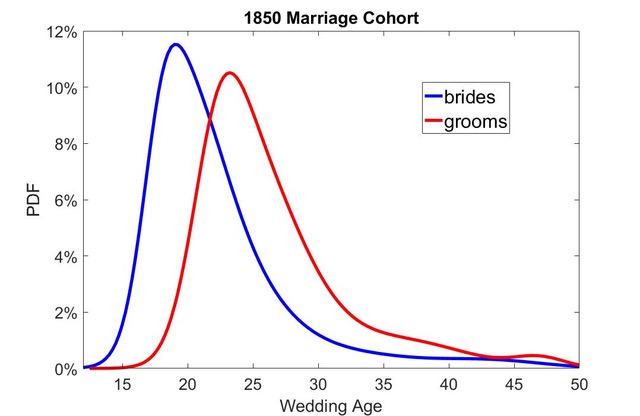
In the past, it was easy for women to have children, during their peak childbearing years, because it was easy to get married around Age 18-20, or at least, by Age 25.
If you don’t make it easy for women to marry, before having children, then they will have children without getting married.
I have only ever known one woman who was the Total Package: 9/10 for looks; 10/10 for brains; and 9/10 (I think) for character. She married a friend of mine.
She went to Japan’s top university, Tokyo University. Tokyo University is sort of like Harvard, if Harvard was competitive. But, Tokyo University is also free to all students, if you can get in. No debt. Also, women don’t feel the need to have a career, to justify the huge expenses of education. They can be well-educated stay-at-home Moms.
She also lived at home, with her parents, until marriage. Now, still married to my friend, she is a stay-at-home mother of two.
In the past, daughters lived at their father’s house until marriage. This did not take long — these girls were typically married around Age 18-20, ideally, and practically, before Age 25. While today’s young women are playing the role of college degenerates, women Age 18-20 in the past were starting big adult responsibilities, of creating a new home and, soon after, filling it with children.
Staying at home was not the goal of a stay-at-home daughter. Rather, it was to get married and start your own household.
During their time at their Father’s house, they often helped raise their younger siblings. There was plenty of housework to do in those days, when it was common for women to make all the clothes, and even, to spin thread and weave cloth. Gardens and food preservation took constant effort.
In the houses of the wealthier, daughters often had private tutors. They were better educated than women today who go to college, but gain nothing but Marxist brainwashing.
In the houses of the less-wealthy, daughters often helped the family financially by becoming schoolteachers, or serving as private tutors.
Recreation of the schoolhouse where Laura Ingalls, author of the Little House on the Prairie books, had her first job as a schoolteacher in 1883, at Age 16.
Recently, there has been a movement toward stay-at-home daughters. Here is the trailer for a recent documentary on stay-at-home daughters, The Return of the Daughters.
westernconservatory.com
It’s the way things were done in the West for many centuries, and it worked. It’s the way things were done in the East too. Needless to say, a lot of Christians didn’t like this idea much.
More young women, or girls, these days are getting the idea that maybe they don’t want to go to college/get a career — even while their parents are pressuring them in that direction. College basically consists of vocational training, and general education. You don’t need vocational training, since you aren’t going to have a job. And, there isn’t much good general education (“Liberal Arts”) going on in universities these days, even Harvard and Yale. Mostly, it is Marxist brainwashing.
I think that women should actually get a general education, in important principles. You would be better off just studying on your own. Read books likeThe Making of America or The Patriot’s History of the United States. If you decide that you do want vocational training, for a womanly occupation of some sort that you can drop after you get married, just do that and skip the rest.
In the past, young women were often schoolteachers, or nurses. It might seem like women didn’t have a lot of occupational options in those days. But, since these women were soon getting married and quitting their jobs in a couple years, there was huge turnover in schoolteachers and nurses. It was enough to employ all the women who wanted jobs, in those days.
Many young women have privately messaged me who no longer want to pursue the career path. They want to learn homemaking skills instead, so they’ll be prepared for marriage and children. Yet, their parents want them to continue on the career path racking up a ton of debt. What should they do? … She needs to tell them that all she wants is to be a wife, mother, and homemaker. If they tell her she must be prepared for the “what ifs…” then she tells them that she will find ways to make money that involve nurturing and doesn’t require a long, expensive education. Plus, if she gets a good career, she may be stuck in it forever since her future husband may value the money she makes over having his wife raise their children. Many women make more money than their husbands these days, and this is NOT good nor healthy for a marriage. Men are called to be the providers, not women.
This is good advice, but a young woman should not “study homemaking skills” instead of “studying career skills.” Homemaking skills are easy. It can take many years to learn how to cook well, but you have many years, so don’t worry about it. What a young woman needs is to find a husband and get married young. Around age 18-20 is the goal. It might take a little longer, but absolutely get it done by Age 25. Besides, God gives you itchy panties so that you will make some babies. I suggest that you follow God’s Plan — after getting married, of course.
Back when Elizabeth Warren was doing something useful, instead of being a Socialist pest, she wrote a book called The Two Income Trap. It was an investigation into how families ended up in bankruptcy.
Warren found that families were not, for the most part, spending money haphazardly or wantonly, on silly luxuries. Rather, their fixed expenses, especially housing, healthcare, and education (including daycare), chewed up all their income, before they even got a chance to squander it on silly stuff. Families were being pushed toward two incomes (working mothers) to pay for all this, and they were still barely able to pay the bills. But, with two working parents, if either of them lost their job, they were on their way to bankruptcy. Thus, it was actually twice as risky to have two working parents, than having one. This was true even of better-off middle-class families, often with a gross income in excess of $100,000 per year.
Around here, I promote the principle of the stay-at-home Mom, preferably one who homeschools. Warren found that one of the biggest things pushing families into bankruptcy was competition to get into the better school districts; which, in the United States, typically meant having to buy a big house. If we use the idea of a house that is 3x income, then even if a family has $200,000 of income, they would be stretched to the limit with a $600,000 home, which is not uncommon these days. Plus, that second income (the working mother) comes with a lot of extra expenses, including daycare, a second car, a lot of take-out food, and other afterschool activities to keep the children busy while Mom is working, or needs a break.
A family that wants to have a Stay-at-Home Mom is going to have to get by on a lot less income. You are going to have to take the load off. I have suggested that a young family look for much cheaper housing, than the typical single-family house. Probably, this means a one or two-bedroom condo. With a one-bedroom, you could probably split it up into two small bedrooms, without too much difficulty (you can do this when you own the condo).
Miami is not the cheapest city in the U.S. But, you can live in a two-bedroom condo in Miami, pretty comfortably. Here is a two-bedroom condo for sale today for $135,000.
There’s a nice interior courtyard with a pool, and also you are on the water. That is bigger than any suburban backyard. And — you don’t have to take care of it! Someone else mows the lawn and cleans the pool. Do something fun on the weekend.
It is a little bit older building, and a little dingy. But, it would clean up nicely.
Good enough.
The total housing costs are estimated at $1,112 a month. Remember, if you have a single-family home, you are going to have to do a lot of repairs and maintenance too. Those roof replacements, regular painting or heater replacements can easily come to $5000/year.
And, it is only $135,000. If you managed to pay off an extra $1000 a month of principal on the mortgage, you would be done in less than ten years.
You should think of 2x income as a good measure for housing costs, or less than this. 3x is “the limit,” but you don’t want to push things to the limit. So, you could afford a place like this with a $70,000 income from one working parent. The neighborhood looks decent enough. You should try to live in a good neighborhood. I would pay more per square foot/get a smaller place, in a better neighborhood.
Warren found that the main motivation pushing parents to buy too much house was an attempt to get into the better school districts. One reason for this is because parents were entirely dependent on the public schools. Since they work all day, they would have little time with their children.
We can skip all this by homeschooling. We still want to live in a better sort of neighborhood, but we don’t care about the schools. Today, even the best public schools are pretty dubious.
Besides housing and education, the big expense for many families is healthcare. Healthcare in the US is a disaster. In other countries, free-market healthcare is very effective and cheap — about half the price of “socialized” healthcare systems. Singapore, for example, with its free-market healthcare system, spends only about 5% of GDP on healthcare, compared to 10% in France and 18% in the U.S. But, Singapore (which is wealthier than the US) is considered to have one of the best healthcare systems in the world.
Today in the U.S., a new “free market” healthcare system is beginning to peek through the cracks. This includes the recent spread of “urgent care” clinics, where you can walk in with no insurance. You get 20-30 minutes with a doctor/nurse practitioner, with some tests, diagnosis and prescriptions if necessary, and you are back out the door only $80 poorer. This is not a copay, it is the full price. Recently, providers have been moving toward “online” solutions (basically, video like Zoom or Skype with a doctor). This is even cheaper: Here is one provider that charges $49 a “visit” (with no other insurance). Modern medicine is largely drugs and surgery. 90% of all drug prescriptions these days are for generics; and probably, some of the remaining 10% could be filled by generics too. Just insist that your doctor only give prescriptions for generic drugs. Then, go to GoodRx to find the cheapest prices. Often, the best prices are much, much, much lower than you might find elsewhere. Generic drugs generally don’t cost much more than Tylenol. Most of the cost actually goes to the pharmacist who fills the prescription. Usually, there is no reason to spend more than $100 a month or so on any drugs. Lipitor (Atorvastatin) is a common pill for heart issues. You can get it for $4.95 for 30 tablets.
For more serious surgery, “medical tourism” is a good solution. Whether it is a US hospital such as the Surgery Center of Oklahoma, or a hospital catering to foreigners in Mexico or Costa Rica (or Singapore), you can get top quality care for prices sometimes one-eighth of what US hospitals charge. As an American citizen without insurance, you can get on a plane and get a heart bypass surgery done in Singapore for about $25,000, compared to $135,000 in the U.S. If you go to Thailand (which has very nice hospitals), it’s more like $18,000. At Tan Tock Seng hospital in Singapore, you can get an appendectomy done for $1,727. Just show up with your Amex card. I heard of one man who had cancer treatments in Thailand over the course of a whole year. A whole year of cancer care, plus all living expenses for a year, cost him a total of $30,000. I bet he had a good time too. Another option is “concierge services,” which means: a private doctor who charges a small fixed price per month for healthcare services. It is usually pretty cheap, around $200 per month.
The point is: a young family today, especially one that aspires to have a Stay-at-Home Mom, needs to get their expenses way, way down. You can’t follow the example of typical families today that can’t get by even with two incomes. Read The Two-Income Trap for a good example of What Not To Do.
You can still have nice things, too. Actually, it doesn’t take many nice things to fill up a 900 square foot condo. $2000 spent at an antique store, or buying used quality furniture on Craigslist, would about do it. Nice things are very cheap these days, especially on the used market. Every day, Boomers are retiring or dying, and all the nice things they accumulated over a lifetime are sold. Too many people live like slobs, when there is really no good reason for this. Get a beautiful dining table, or bedroom set. Having a nice home, and all the work that is involved in achieving that, is one of the principal duties of the Stay-at-Home Mom.
You can wear nice clothes without being a sexpot all the time. Here are two Twitter feeds that look at classic fashion.
One is B of Beauty (@bof_beauty). Actually, a lot of these are very sexy, but in a high-end sort of way. If you want to be a Trophy Wife, not a Side Chick, do it like this.
The other is Our World (@oloiux):
This has some new pictures of new clothes that are not part of any historical period, but wouldn’t have been out of place in 1910.
This is very modest “covered up below the neck” look, but very beautiful!
If you want to meet Prince Charming, it helps to dress like Princess Charming.
Women wonder why men are not romantic anymore.
When a man goes looking for “the mother of his children,” he is looking for something like this.
You don’t have to wear jeans and t-shirts every day.
A still from the TV show Little House on the Prairie, showing a one-room schoolhouse in the Dakota Territory, during the 1880s.