Turbo-Simping

There is much to admire in the way people in the nineteenth century carried about the process of getting married — or, Traditional Courtship. The Victorian Age was a high-water time even then for Courtship, compared to the more corrupt eighteenth century. It was, perhaps, a low-water time for sexual satisfaction, however. They seemed to be very bad at sex, even by today’s low standards.

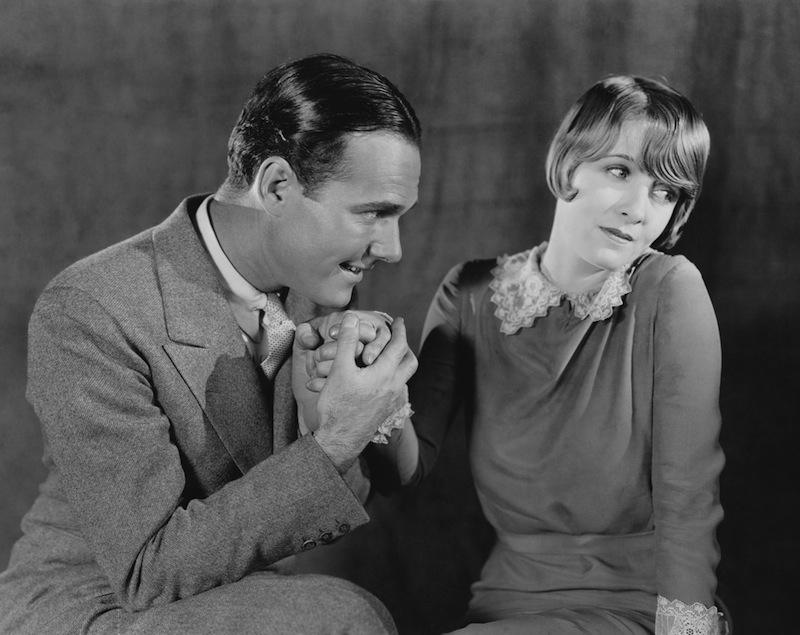
Nevertheless, as much as we can admire the way things were done in those days, it did have a flaw — and that flaw was: Chivalry. As Dalrock has explained in great detail, Chivalry is, basically, simping — a man debasing himself before a woman, becoming a beggar for her affection. Chivalry is “courtly love,” specifically, the love of a courtier (often a knight — i.e., a soldier) for a noble woman, commonly already married to a nobleman. The courtier was, literally, the subject (servant) of the Lady, so the servant-like behavior made sense.

Prince Harry, of Britain, and James Hewitt at a similar age. This is Chivalry — “Courtly Love.”

This is bad on many levels, among them that women really don’t like it. Women want a man of power and leadership, who invites the woman to become part of His Thing — his Frame. He does not grovel to be accepted into her Frame.

Here we have a key moment in The Portrait of a Lady (1881), by Henry James. It is considered one of the finest novels in English by an American. Isabelle Archer is a pretty American girl from an upper-middle-class family. She is nice enough, but doesn’t really have any particular advantages besides a pretty face. After the death of her parents, she doesn’t have much to do, so she is invited to England by her mother’s sister, who married a rich American banker who retired to the English countryside. Here, she meets with one of her uncle’s neighbors, Lord Warburton.

In Pride and Prejudice (1813), we are told that Mr. Darcy is very rich, because he has an income of ten thousand pounds a year. A British pound was about a quarter of an ounce of gold, so that is equivalent to about 2500 ounces of gold, or $3,750,000 per year of income (not wealth). If we assume that the income is 3% of wealth, that implies wealth of about $3,750,000/3% or $125 million. Anyway, this is what it looks like — here is Darcy’s house, known as Pemberly:

By 1880, England had grown much wealthier. Lord Warburton does not have an income of 10,000 pounds per year — his income is 100,000 pounds. And, unlike today, this currency did not lose value. We could estimate his wealth around $1,250,000,000 in today’s money. Warburton was a billionaire. He did not have just one estate. He had six. And, as a Lord, he was not only literal lord and master of his own estate(s), and all the workers upon it (the money came from agricultural production, and, often, government bonds), and also the country seat that he likely administered as a kind of county government — somewhat like the mayor of a town. He had an inherited seat in the House of Lords, one of the houses of Parliament. So, think of a billionaire business owner who is also a Mayor and a Senator.

Lord Warburton is, perhaps, about 30 or 32 years old. He is not said to be physically ugly, which means that he was heart-rendingly attractive, as is any man who is under 50, not fat, and a billionaire. Isabelle Archer is 18 or 19.

In this scene, Lord Warburton proposes marriage to Isabelle Archer.

“My dear Isabelle,” Warburton began. “We have known each other only a few days. And yet, I have decided to ask you to be my wife. Perhaps it is your American sense of adventure and self-sufficiency. Or, perhaps your charming American accent. I have had many offers from many women. They throw themselves at me. Actually, it is their mothers that throw them at me. They are very nice girls, from the finest families. But, I find them dull, and you excite me.

“Any man wishes to have a family, but it is especially important for me, as I must have an heir, not only of my estate, but of my position in the leadership of this country, one of the greatest countries on Earth. Thus, the mother of my children must aspire to raise our children to their high station, and great responsibilities. Also, I have many duties, not only to manage my estates, but in society and even in Parliament and in diplomatic matters. This will require a woman of some capability, and I think you will excel at this. Do not be too intimidated by the demands of society. In time, you will excel at it. In truth, these society women are not so good as you are already.

“Let us be married next month, with the usual pomp and pageantry. It is not so difficult. All you have to do is show up and wear a dress. I will have my people take care of the other details. Then we will go to Italy for a month, where a friend of mine has a villa that we can borrow. I think that will be a lot of fun for both of us.”

“Oh, Warburton, I don’t know what to say,” Isabella sighed, as her head whirled. “Of course I accept. But, can we be married tomorrow? I want to go to Italy with you right away.”

OK, I just made that up. That is what Lord Warburton should have said. That is what the Warburton-like character does in fact say, in any one of hundreds of lookalike how-I-married-a-billionaire romance novels. And if the silly bitch still said no, Warburton could have said: “Well, this is where you can call [on] me when you change your mind.”

“Silly bitch,” is what Isabelle Archer’s own father would have called her, to her face, if he was still alive, and heard that she turned down an offer from Lord Warburton. And doesn’t Father know best?

But, this is what Warburton actually said, according to Henry James:

“I care nothing for Gardencourt,” said her companion. “I care only for you.”

“You’ve known me too short a time to have a right to say that, and I can’t believe you’re serious.”

These words of Isabel’s were not perfectly sincere, for she had no doubt whatever that he himself was. They were simply a tribute to the fact, of which she was perfectly aware, that those he had just uttered would have excited surprise on the part of a vulgar world. And, moreover, if anything beside the sense she had already acquired that Lord Warburton was not a loose thinker had been needed to convince her, the tone in which he replied would quite have served the purpose.

“One’s right in such a matter is not measured by the time, Miss Archer; it’s measured by the feeling itself. If I were to wait three months it would make no difference; I shall not be more sure of what I mean than I am to-day. Of course I’ve seen you very little, but my impression dates from the very first hour we met. I lost no time, I fell in love with you then. It was at first sight, as the novels say; I know now that’s not a fancy-phrase, and I shall think better of novels for evermore. Those two days I spent here settled it; I don’t know whether you suspected I was doing so, but I paid—mentally speaking I mean—the greatest possible attention to you. Nothing you said, nothing you did, was lost upon me. When you came to Lockleigh the other day—or rather when you went away—I was perfectly sure. Nevertheless I made up my mind to think it over and to question myself narrowly. I’ve done so; all these days I’ve done nothing else. I don’t make mistakes about such things; I’m a very judicious animal. I don’t go off easily, but when I’m touched, it’s for life. It’s for life, Miss Archer, it’s for life,” Lord Warburton repeated in the kindest, tenderest, pleasantest voice Isabel had ever heard, and looking at her with eyes charged with the light of a passion that had sifted itself clear of the baser parts of emotion—the heat, the violence, the unreason—and that burned as steadily as a lamp in a windless place.

By tacit consent, as he talked, they had walked more and more slowly, and at last they stopped and he took her hand. “Ah, Lord Warburton, how little you know me!” Isabel said very gently. Gently too she drew her hand away.

“Don’t taunt me with that; that I don’t know you better makes me unhappy enough already; it’s all my loss. But that’s what I want, and it seems to me I’m taking the best way. If you’ll be my wife, then I shall know you, and when I tell you all the good I think of you you’ll not be able to say it’s from ignorance.”

“If you know me little I know you even less,” said Isabel.

“You mean that, unlike yourself, I may not improve on acquaintance? Ah, of course that’s very possible. But think, to speak to you as I do, how determined I must be to try and give satisfaction! You do like me rather, don’t you?”

“I like you very much, Lord Warburton,” she answered; and at this moment she liked him immensely.

“I thank you for saying that; it shows you don’t regard me as a stranger. I really believe I’ve filled all the other relations of life very creditably, and I don’t see why I shouldn’t fill this one—in which I offer myself to you—seeing that I care so much more about it. Ask the people who know me well; I’ve friends who’ll speak for me.”

“I don’t need the recommendation of your friends,” said Isabel.

“Ah now, that’s delightful of you. You believe in me yourself.”

“Completely,” Isabel declared. She quite glowed there, inwardly, with the pleasure of feeling she did.

The light in her companion’s eyes turned into a smile, and he gave a long exhalation of joy. “If you’re mistaken, Miss Archer, let me lose all I possess!”

No woman on Earth would be interested in a man who would throw all he has away for a stupid bitch, even if she herself is that stupid bitch. This turbo-simpery produces much the effect that we would expect — a notable absence of pussy-tingles:

She wondered whether he meant this for a reminder that he was rich, and, on the instant, felt sure that he didn’t. He was thinking that, as he would have said himself; and indeed he might safely leave it to the memory of any interlocutor, especially of one to whom he was offering his hand. Isabel had prayed that she might not be agitated, and her mind was tranquil enough, even while she listened and asked herself what it was best she should say, to indulge in this incidental criticism. What she should say, had she asked herself? Her foremost wish was to say something if possible not less kind than what he had said to her. His words had carried perfect conviction with them; she felt she did, all so mysteriously, matter to him. “I thank you more than I can say for your offer,” she returned at last. “It does me great honour.”

“Ah, don’t say that!” he broke out. “I was afraid you’d say something like that. I don’t see what you’ve to do with that sort of thing. I don’t see why you should thank me—it’s I who ought to thank you for listening to me: a man you know so little coming down on you with such a thumper! Of course it’s a great question; I must tell you that I’d rather ask it than have it to answer myself. But the way you’ve listened—or at least your having listened at all—gives me some hope.”

“Don’t hope too much,” Isabel said.

They did not get married.

This is fiction, of course, but to be believable (this is supposed to be a Great Novel, not a cheapie romance) it must either reflect reality, or at least, reflect some ideals held at the time. You see this kind of turbo-simping (chivalry) throughout all the novels of that time.

So, it seems that we cannot simply imitate old forms and ideals. We will have to create something new — an updated version of Traditional Courtship, with the Chivalry carefully excised, like a cancerous growth.

Or, as Sigma Frame recently put it:

No.

Yes.

Lady, by Roosh V

Lady is a new how-to guide by Daryush Valizadeh, also known as Roosh V. Roosh, long known as a writer of pickup-artist books, in recent years has had something of a conversion, including the adoption of an active Christianity, and now intends to tell young women how they should navigate the meatgrinder of “dating” today, with the intention of “how to meet and keep a good man for love and marriage.”

Like a number of other men in the “redpill” space, he came up to The Abyss, and decided to turn back. His conclusions are much like my own. But most of all, he follows our rule here, which is: Tell The Bitches What To Do. Young women really have no hope of figuring this out on their own without the assistance of an experienced older male like Roosh; especially, in the absence of assistance from another experienced older male, her own father. If you don’t Tell Them What To Do, they won’t know what to do. Let’s take a look.

It turns out that feminism, and the idea of equality in general, are entirely dedicated to feeding your devil and decreasing the chance that you will get married, or if you happen to marry, stay happily married. If feminism feeds the negative side of female nature, why do all the major institutions support it? Why is it the default mentality among modern women? As I said earlier, the direct answer is money. Feminism has two aims. First, it’s to double the supply of labor in the workforce in order to reduce the price of wages. Second, it’s to weaken the family unit so that women depend on corporations and government, which the elite control, instead of strong men.

You are being thrown under the bus so that men at the very top can make an extra billion in profits every year, and more money means more power. You’re being manipulated by a group of ultra-rich oligarchs and their useful idiots in universities, government, and the media to have contempt for men and seek to become “independent” from them. They train you to put career, status, hedonism, and fame before love, family, and God, brainwashing you to think that normal men are trying to enslave you with child-raising and household chores. This causes you to voluntarily enslave yourself to corporate bosses and massproduced consumer products.

Mmmm, yep. That’s pretty much the way it is.

Roosh recommends that women live at home with their fathers until they are married.

Instead of asking how you can find fulfillment through a career, it’s better to ask how holding down a basic job will enable you to find fulfillment through a good man with whom you can establish a family. If you leave your parents’ home, you’re essentially forcing yourself to have a career so that you can pay for the high cost of enjoying a Sex and the City lifestyle. A better solution is to live with your parents so that you can devote more of your energy to finding a husband instead of wasting it on the rat race.

Your parents are unlikely to mind you living at home, and doing so makes it harder for you to feed your devil through casual sex. It’s so easy to have sex while living alone that I’ve told men to assume that a woman has at least three new sexual partners for every year she has lived on her own. It won’t take long for her ability to form a pair-bond with a good man to be irreversibly damaged. When I wanted only sex from girls, I deliberately filtered out the ones who lived with their parents, because they were much harder to sleep with. Now, I am unable to contain my excitement when I meet a girl who lives at home and has to check in with mom by sending a text message stating she’ll be home soon. While you may think that I’m the exception in how I judge girls by their family values, there is a reactionary trend among men against women who have a feminist lifestyle.

I wonder if the “strong, independent” women will figure out that men want women who have minor jobs that they will immediately discard in favor of a family, and who live at home with their fathers?

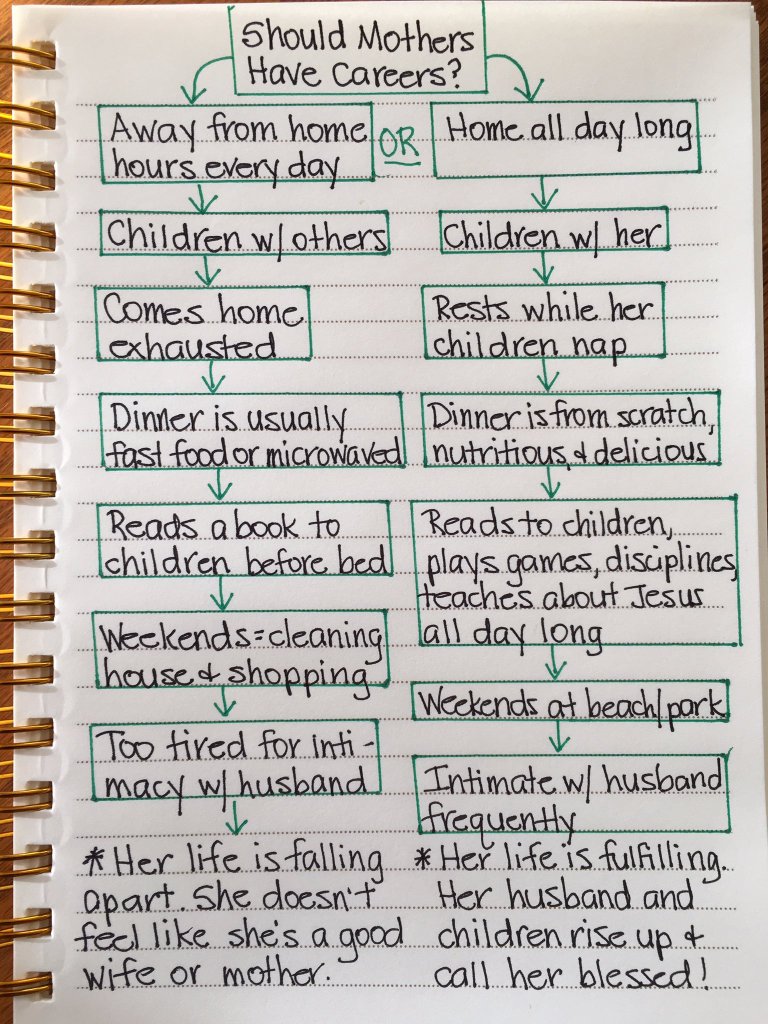
Women who marry should be stay-at-home mothers.

Single-income households won’t have a lavish lifestyle, but they will be full of meaning because the mother can spend much more time at home instead of devoting her energy to pleasing the demands of a corporate boss while her children are raised by strangers making close to minimum wage. Tales of abuse in day-care centers are enough for me to insist that my children never step foot in one. I find it unfortunate that so many women go against their maternal instincts and leave their children with strangers for most of the day during their most crucial years of development.

Is it possible to have both a successful career and a happy family? Unless you’re a millionaire and can hire an army of assistants and nannies, such as Lean In author and Facebook executive Sheryl Sandberg, the answer is no. A typical middle-class woman will not be able to live the feminist dream of pursuing a high-powered career while raising a family. It cuts her nature in two, causing intense inner conflict and dissatisfaction. At work, she is forced to feed her devil, compete like a man, and pursue materialist gains for the sake of money, while at home she is expected to listen to her angel and be a nurturing mother who also wants to please her husband. This doesn’t work in practice. What ends up happening is that she stays in work mode at home, makes demands on her husband as if he were a co-worker, and treats her children like a business project to be managed, and this is assuming she has any energy left after a full day at the office.

Don’t go to college.

First, let’s describe what happens to a typical 18-yearold girl who goes to university today. She will spend four years racking up tens of thousands of dollars in debt for a degree that is likely to be in the humanities or social sciences. She will be immersed in an environment that promotes hooking up with men who are “hot,” “sexy,” or “popular.” She will spend hundreds of hours studying and
reading books, but zero hours becoming a good wife from learning basic cooking or homemaking skills. No matter what she majors in, she will be indoctrinated in feminism and embrace the belief that men are the enemy, pushing family down her list of priorities. And she will consume copious amounts of junk food, alcohol, and maybe drugs.

Some women have been able to resist the temptations of a university environment, but it’s safe to say that most emerge from the experience spiritually poorer, less in tune with their feminine nature, more committed to securing a career, more in debt thanks to student loans, and less likely to get married within five years. For every story you hear of college sweethearts getting married, you hear dozens more of a woman who dyed her hair green, got her first tattoo, experienced a threesome, and got pumped and dumped by multiple Chads. Unless a woman goes to college specifically with the aim of meeting a potential husband, the outcome will be negative.

If they are interested, women should pursue education and career after their childcare duties are done.

Let’s imagine that you skip university and become a low-paying assistant in a predominately male office. One of these men with a promising future falls in love with you and proposes marriage. You get married at the age of 22 and become pregnant a year later. It is assumed that once you have the baby, you will quit your job, which doesn’t bring in much income anyway. As your child grows up, you will have more time to focus on your hobbies. And then you get pregnant again.

You and your husband decide that two children are enough. Eventually, both of them will be in elementary school. You’ll now have more free time because when the kids come home from school, they won’t need constant attention and care as was the case when they were younger. This is when it makes sense for you to pursue higher education if you still want to. While your children are at school, you are free to go to school part-time, assuming it doesn’t conflict with your household duties. When they become young adults and go to university, you have the option of easing into a full-time career. Yes, your female co-workers will be ahead of you on the corporate ladder, and you will start at a lower pay grade, but you will have something they won’t: grown-up children. …

[T]he culture should encourage only men to go to university so women can focus on starting a family at an age that is in line with their biological clock.

Women should be a virgin at marriage, and courtship should be short. Get married and get it on.

If you’re a virgin, you may be wondering if it’s better to wait until marriage before having sex. I personally think that is a great idea, and I would consider marrying a virgin myself if the courtship wasn’t longer than a year, but this is challenging to pull off if you’re not embedded within a religious community.

I used to look for Sexy Stacy with her flirty behavior, revealing clothing, and “come hither” face, but now I seek out Bookworm Betty or Virgin Vicky, who is shy and slightly awkward with understated beauty.

Being attracted to the “librarian type” didn’t happen to me overnight. It was a process that took years after repeated experiences with Sexy Stacys taught me they are not suitable for starting a family.

We may not think very much about Roosh’s history as a pickup artist (Roosh himself doesn’t think very much of it.) But hardly anyone knows more about “dating” and “hookups” than Roosh. Women: get married young. Start a family. Be a stay-at-home mom. Avoid premarital sex. Stay married.

Courtship, Circa 1910

Sometimes we wonder if everyone actually participated in the Courtship process, or was it only people who lived in country estates? Here is a description of courtship among the working classes, from Moira Weigel’s book Labor of Love.

The son of a rabbi, Samuel Chotzinoff came with his family from Vitebsk, Russia, to New York when he was seventeen years old. They lived in a housing project on the Lower East Side of Manhattan. Chotzinoff grew up to be a well-known music critic, and in his memoirs he described their home in the Stanton Street Settlement.

“The average apartment consisted of three rooms: a kitchen, a parlor, and a doorless and windowless bedroom between.

“The etiquette of courting was strict,” he added.

If a young man came to call on his older sister, the two of them would have to crowd in the kitchen. If his parents were out, they made Samuel stay in to spy on his sister and any suitors who turned up.

Of course, traditional parents would have preferred to set up their children through family members of matchmakers. In the Old Country, your family and community had controlled courtship. Many ethnic and religious groups funded political and theatrical clubs in the hopes that their children would meet there.

There is a lot in this little passage: a formalized “visiting” custom, supervision, the participation of parents, “matchmakers” and community, the establishment of institutions where young people could meet, and more. It wasn’t the Feminist Life Script and “dating” without sex.

Labor of Love (2016), by Moira Weigel

Labor of Love: The Invention of Dating (2016), by Moira Weigel, is a nice, short book about the history of “dating,” or, if you like, the replacement of Traditional Courtship, beginning around 1890 but really getting going after 1920.

This book could have gone wrong in many ways. One of the reviews calls it “a radical Marxist feminist tract disguised as a salmon-pink self-help book.” It is not that, thankfully, although the reviewer wishes that it was. There is more detail about faggots and trannies than I care for, but that is to be expected in these dark days. The author has a PhD in comparative literature from Yale, but she also got married, so she is not completely nuts. She looks about 30 on the back cover, and she says the book arose from her attempts to figure out what exactly was this thing that she spent so much time doing, and where it came from.

Fortunately, most of the book is history rather than opinion/analysis (the author’s attempts to do this in the last chapter are rather pathetic), and since it covers about 130 years of history in 267 pages, it is a fairly light treatment of the major features of each age. The author did a lot of work reading from materials from those times — advice columns from the 1920s, self-help books from the 1950s, or How To Court guides from the 1890s. There is a lot of valuable material in this historical study.

Basically, “dating” arose from the trend, beginning around 1890, for young men and women to migrate from farming communities to cities. In Courtship, women lived at their father’s houses, until they moved to the house of their new husbands. However, these single working women, living alone in the big city, were not so constrained, and soon began to meet with similarly single and displaced men. From the beginning, it was rather degenerate. Often, women would walk around amusement centers hoping for attention from men. Since they often had no money, they would hope the men would buy them something to eat. Kissing and sex often followed soon afterwards. The 1913 term for them was “charity cunts.” Police didn’t know what to do with these women. They appeared to be very cheap prostitutes. But, the women themselves, at times finding themselves in jail, would insist that they were doing it for love.

This was a fringe activity at first, but by the 1920s, “dating” had become more mainstream, and also, as it assimilated the mainstream, somewhat less degenerate. If they weren’t leaving their parents’ house to go to the big city to get a job, by this time women were often going to college. The “boyfriend” appears, which doesn’t exist in Traditional Courtship.

All in all, the book confirms my view that “dating” has been one long slope of disintegration from traditional Courtship models that existed for centuries. In 1946, the anthropologist Margaret Mead, who had become reknown for her studies of courtship processes worldwide, was asked to give a talk at Stanford University about American Courtship Rituals. She did not see “dating” as a dysfunctional courtship ritual. Dating, she said, had nothing to do with courtship. Americans had no courtship rituals at all.

Sexual Compatibility

I thought I would add a comment to the recent post at SigmaFrame regarding concerns among many Christian men (virgins or nearly so) as to whether they can achieve sexual “compatibility” with their future wife, without giving it a try beforehand.

Here is a quote from that post, from a young man with some concerns:

Caterpillar: I’m probably overthinking it but I just fail to understand how I’m going to end up with any semblance of a fulfilling physical relationship by me and a hypothetical potential wife going from none to anything goes after saying “I do”.  But I suppose it will just happen naturally or it will just happen because I’ve done what God said and stayed chaste until marriage or something…

So again, the question I keep asking is something like “How do I, coming from a rather traditional, “hands-off, no touching” approach to relationships (and presumably intending to marry a similar woman) understand whether we will be sexually compatible for the rest of my / our life?”  Perhaps there is no good / straightforward / universal answer.  As I have a tendency to do, I’m probably looking for an “equation” that I can solve and get “the answer”.  One way to look at it is that the process of discovery along the way is what makes life interesting.  But another way to look at it is that I’d like to seek the advice of men with more experience than me so that I might make fewer mistakes.

For men, “sexual compatibility” is an easy matter: if she is not repulsive (grossly fat), and you find her sexy with her clothes on, then there is hardly any chance of a problem. It is true that some women have sexual hangups of one sort or another, but those can be resolved in time. Men with some experience (with their own wives or other women) would probably express some puzzlement that this notion is even being considered.

In general, I find that a woman’s appearance is somewhat less important during the sex act itself, than it is during the earlier stages — where a man appreciates her beauty from some distance. A 5/10 girl can be a ton of fun in bed, even if she is somewhat uninspiring in day-to-day life. Likewise, a 10/10 girl who lacks all responsiveness in bed is inevitably a disappointment. Even so, you should probably avoid fatties.

Unfortunately, for women, more previous history tends to mean more dissatisfaction with the man she married — the “alpha widow” as mentioned in the linked post. This is yet another factor in favor of the virgin bride. She will be happy with what she has.

Since it appears that many men are bad at sex, a man today should have some ambition to be a capable lover. I do not think this is very hard to do, but it appears that most men fail here.

If you did have a 10/10 wife who was unresponsive (the old word was “frigid”) in bed, I think this can be resolved in time if she is willing to do so. Some women perhaps think they will control their men by restricting sex, and to do so they suppress their own sexual response. Women damaged by “dating” may want to avoid “catching feelings,” and steel themselves for the breakup they expect soon. But, if a woman actually wants to have a good time, I think it is nearly certain that she can eventually arrive at that goal, without too much difficulty. Then you would have a 10/10 wife who was also a sex goddess. This might be rather a nice thing.

In general, sexual responsiveness and satisfaction in a woman tends to be related to:

  1. Women who feel that they are in secure long-term relationships tend to have more fun. They feel that they can trust their man, and “let down their guard.”
  2. Women who “submit”/“surrender” to their husbands, or in other words take a traditional Biblical role, have more fun.

Men’s Guide To Sex

You wouldn’t think there would be any need to write a Guide to Sex. All the animals do it, without having to read about it beforehand. But, it seems that a lot of men today don’t know how to do it, or at least, how to do it well enough.

I went to a private boarding school for high school (actually, one year of high school). During that time, there was a speaker on the topic of sex. The audience was the 250 or so male and female students, age 14-18, plus about 60 faculty and spouses.

The speaker asked a question: Who is capable of more orgasms, men or women?

I raised my hand. Everybody knows that women have more fun. Even me, who had never actually done it, at that time.

There was one other woman who raised her hand, the wife of a faculty member. Then she looked around, and seeing that nobody else had their hand up (including her husband, sitting next to her), except for me (who was sitting directly behind so she couldn’t see me), she sort of put it down again. I kept my hand up. Why, I don’t know.

And so, whether from hearsay (most students) or experience (faculty), people seemed to think that men have more fun during sex.

Today, we hear about the orgasm deficit. Rather than having much more fun than men, women seem to be having much less. I have heard promiscuous women say that about 10% of men are good at sex. I think she means — not bad. In other words: not that 10% of men are in the top 10%, but that only 10% of men meet some kind of minimum standard of non-disappointment.

The speaker’s opinion was that women had more fun, since they were capable of multiple orgasms. The world record for the most orgasms in an hour is: 134. Plus, women’s orgasms can be longer and more intense.

That is a big number, but in my (later) experience, it was common for a woman to have ten or more orgasms during a “session,” and there are sometimes multiple “sessions.” This didn’t happen all the time, or most of the time, but it did happen. I think it could happen with nearly all women, given enough time together.

This is a lot of fun, for men and for women.

There is no special technique to this, or at least nothing that I am going to go into now, but there are a few basic guidelines. There are certain roles to play: the man’s role is to make the woman have a good time, and the woman’s role is to have a good time. The man is somewhat active; the woman somewhat passive. The man takes the lead, and the woman follows. If you look at the basic roles of formal dancing, it is much the same. The man always “leads” in dancing, but doesn’t the woman have most of the fun?

The man gets her off; she can’t really get off without his help.

The woman’s role is to have a good time. This is something of an internal process. It is external for the man. He does to another. For a woman, it is more of an internal experience. (This is exactly analogous to the process of conception itself.) If a woman doesn’t know what else to do — if she has no experience in these matters — she can just lie quietly on the bed and let the man have his way with her. I don’t mean that she continues to lie quietly, but rather, that she responds to his stimulus.

The process of learning, internally, how to have a good time can take a while for a woman. Probably, weeks or months.

The woman is attentive to her internal state. The man should be attentive to … the woman’s internal state. This is apparent usually from her breath, voice, movements, etc. You can think of playing her like a musical instrument. Be creative and artistic. Don’t just pound on the keys with your fists. If it’s not working, try something else.

A woman should make at least a little noise, so the man can be aware of her internal state. Women do this naturally, but some women suppress this, presumably because they don’t want other people to hear. Screaming is OK. Although the man is paying attention to the woman’s state, nevertheless he must Be The Big Boss, and take charge.

I think that most women can become “very responsive.” It usually takes some time to get there. She has to practice a little bit. There are some women who feel nothing at all. But, I think that is on purpose: they don’t want to feel anything. If they change their mind about that, they could eventually remedy the problem. For men, I think it helps if you simply are aware that this is what you are doing. It is a sort of attitude. For one thing, you don’t just stop after one. You aren’t going to get to two if you stop at one. Just keep going, perhaps with a rise and fall of intensity. Also, don’t assume that a woman’s orgasm is as long as a man’s — perhaps, ten seconds. Just keep going. Eventually, she will sort of run out of energy, and things will come to a natural conclusion. Maybe it will be 20-30 seconds. But, she might be ready again in a couple minutes.

Sometimes women will actually say: “Don’t stop!” For some reason, when men hear this, they stop. Other times, if it gets really intense, a woman may say: “Stop!” Obviously, don’t stop. Just push her over the cliff. She will thank you later, when she regains the power of speech.

Usually, men find this whole process very satisfying. But, perhaps you are disappointed that men don’t have the same kind of fun that women do. The Tantric people say that men can do this. Men can train themselves to separate ejaculation from the orgasmic response, and have orgasms like women. But, this is certainly rare.

There was a popular book in the 1980s, the One Hour Orgasm. Actually, they mean a series of rising and falling orgasms, over a period that, with practice, can reach up to an hour. It is not a bad place to start. Yes, I tried it. It worked.

Get Sexy

I was reading in the comments of a YouTube video (most of the best material is there) about a man who tried imitating the manner of the Sexy Alpha guys in his office, without actually doing anything. He was married with children, and never bothered to interact with any women beyond “hello.” He just decided to swagger and talk like a sexy, manly dude, instead of a meek office drone. Think about imitating Sean Connery, George Clooney or Harrison Ford if it helps. There were no motorcycles or tattoos involved.

Apparently this was quite successful. Women in his office, twenty years younger, would fall in love with him. At one point, a young woman actually took her boyfriend into the office, and pointed him out: “That guy over there.” Apparently, she wanted her boyfriend to act that way; or perhaps, he wanted to see who she was talking about all the time.

This is good for those men who are actually happy with home and family. You can be sexy too. It seems to be mostly just a change in attitude. So why not?

If this short, old guy can do it … you can do it.

58-year-old married guy with children, in a suit:

This is the Ugly Face of Oppression

A day in the life of an upper-middle-class young mother and her baby, in Tokyo.

Most young Japanese moms don’t wear kimono when out about town. But, I wish they did. (This woman spent five years as a Geisha apprentice, and is definitely a Level 5 Housewife when it comes to traditional clothing.)

If you want to see the Oppression part, it is at the end (15:00), where, in return for all this luxury and freedom, her husband Demands a dinner consisting of rice porridge and a beer, while sitting on the sofa. Toxic Patriarchy Alert! Hide your eyes while she Submits to this horror.

Young Mothers

In the scheme I am drawing out here, which is the scheme that was used for centuries before 1900 or so, women get married young, and they have children. It tended to happen, in the era before contraception. But, shouldn’t a woman have children during her period of peak fertility? Nature lines up a woman’s peak fertility and peak attractiveness for a reason, and we know what the reason is: making babies.

I am mentioning this because we are going to have to get our heads around young mothers of nineteen or twenty years old. Among other advantages of this scheme, it propels the young woman directly into big grown-up tasks and adult responsibilities. No decade of party sluttery here. It also tends to cement a marriage, since a woman with children is going to want to have a husband, and also, a twenty-year-old woman with young children is not likely to go searching for an extra guy on the side while her husband is away at work.

The advantage here comes in the out-years. By age 45, a woman likely has all her children out of the house, and has a good twenty years to build a career if she wants to, with no conflict with children.

The Feminist Life Script, where women spend their twenties partying around, or going from one transient LTR to another, while they are waiting until they turn 28 and can finally get married, has unfortunately become so dominant today that I think women who actually are married young end up searching for a way to “get back on track”.

I had a friend who was from a wealthy family on the Upper West Side of New York. Her parents probably saw the likely outcome if she (a 10/10 girl with money) was released into the social environment of Sodom On The Hudson without restraints. In any case, she was married around age 20. But, alas for her parents, it didn’t work. She was divorced soon afterwards. Fortunately, there were no children involved. When I knew her, at age 30 (and still a 10/10 girl), she was looking for a husband. When I asked about her divorce, she explained: “I was just too young.”

This is a problem with young marriages today: it deviates so much from the Feminist Life Script that women are soon looking for a way to get back to in-group norms, which means getting divorced.

Unfortunately, I couldn’t really recommend that any man marry her, since she was practically the definition of Trouble On Heels. A man with money would probably be better off marrying a hispanic hotel maid. Literally a hispanic hotel maid.

This is Steve Cohen, one of the most successful Wall Street money managers of his generation, with an estimated net worth of $14 billion. That is his wife Alexandra, to whom he has been married for 28 years. Of Puerto Rican descent, she grew up in the projects (government social housing) of Harlem. When he met her, she was a single mom with three children. They had four more children together. Apparently, they met through a dating service. Of twenty women, she was the only one that responded.

I’m not sure I like the single-mother part, but: good choice, Steve.

Is he not better off with his choice of a wife (let’s guess) than 80%+ of professional-class men who marry? Is he worse off because she didn’t graduate from Princeton? Is she?

My point here is: To make this work, young women will have to get married young, and stay married. Probably, they should have children quickly. Get all the childbearing done by age 25, age 30 at the latest. This will require substantial deviation from the Feminist Life Script, or, in other words, the actions of the Herd. If women are aware of this beforehand, it shouldn’t be too hard to do.

Social Dancing

In the past, social dancing was a major means by which young people would meet each other. Boys and girls together would often go to dance school to practice.

I was in Las Vegas and went to a dance club recently, just to look around. I happened to have a free ticket, which cost $23 otherwise. I didn’t really like dance clubs much when I was younger, but I can appreciate them. In the 1990s, dance music was disposable bubblegum but at least you could dance to it, and people did dance to it, enthusiastically. The music at this club sounded like raw sewage being poured over a pile of rusted scrap metal, accompanied by mortar fire. Nobody was actually dancing. Yes, at a Vegas dance club with a $23 door, nobody was dancing. They were standing around, on the dance floor, like corporate cocktail hour, but not talking, of course, because that was impossible.

So I left the club and went to see the free live band, which was pretty good. People were dancing — people of all ages. There were two people (who didn’t know each other), who looked in their early sixties. When the live band began playing some late-1970s disco tunes, both of them started into these elaborate, sinuous movements — the ghosts of 1970s disco.

I think these days we have nothing left to lose, so we might as well being to learn how to dance properly again.

Other times, it doesn’t go so well.