The “Purity” Movement

I was not a participant in the “purity” movement and have learned about it only after-the-fact and second-hand. Nevertheless, as the biggest recent movement to revive Traditional Courtship, it deserves close scrutiny. By the accounts of those that participated, it was somewhat troubled and problematic.

As I have mentioned, for the last several years I have been in a long review of the big nineteenth century novels. This has been fruitful in many ways, and one of them is to examine the courtship process of that time “from the inside,” from the standpoint of participants, even if fictional representations. From this I think it has become easier to identify where the modern “purity” movement, and other no-sex-before-marriage strategies, have differed from that successful pre-1920 pattern.

I mentioned earlier the book Courtship in Crisis: The Case for Traditional Dating (2015), by Thomas Umstaddt. Umstaddt was in fact an eager participant in the Purity Movement, and came away disappointed enough that he wrote a book proposing modifications to it.

We also have this recent and insightful post about related topics from Sigma Frame:

2020-01-17: The Sin of Prioritizing Purity Above Marriage

Let us leave aside for now the difficulties with marriage (and divorce) today following the wedding ceremony. We will consider “courtship” to be limited to the process of getting to the wedding day. Basically, both young women and young men, both participants in the Purity Movement and excellent prospective spouses, did not end up getting married to each other.

I will try to summarize some points where things seem to have gone awry. (Those who are more familiar with the matter may correct me.)

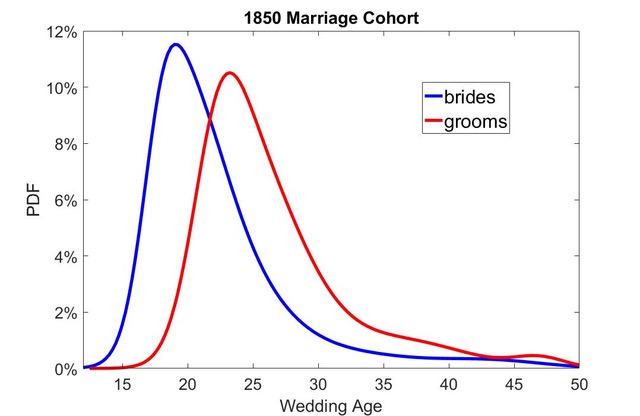
Maintaining the Feminist Life Script: In Courtship, in the pre-1920 era, women married young. 18-20 was the prime window, with 16-25 the practical range. Women did not have to do anything besides become wives — essentially, stay-at-home wives (although the division between work and home was not as great in those days). After marrying young, they typically had children quickly, and thus, within a year or two of the wedding, they were up to their neck in childcare duties — big adult responsibilities. More recently, the idea of “no sex before marriage” has been maintained, but this “no sex” period has been extended to the 28-30 period, which bypasses nearly the entirety of a woman’s fertility peak, and also, is far too grueling for any mortal woman to be expected to endure.

To get married at 18, a woman might be generating interest among potential suitors (typically the men in her neighborhood) from the age of 14. Today, any such attraction is assumed to be transient, since the woman is to leave and go to college. Then, any attraction at college is assumed to be transient, since the woman is assumed to be moving on to some sort of career. When a woman is finally “ready” to look for a husband around age 28, she finds herself in an atomized community where the men she meets are most likely complete strangers.

An overemphasis on “purity.” The purpose of courtship was to get married, since women really didn’t have anything else to do but either a) get married; or b) coast along quietly living at her father’s house. Unmarried older women (over 30) often became part of the households of their brothers, or ended up taking care of their parents in their old age. Most women got married, and they did it before age 23. Of course they wanted to maintain “purity” until their wedding day, but it wasn’t that long a time — in fact, many women make it to twenty today without losing their virginity, even when that was not any kind of rational plan. Unfortunately, the focus of the “purity movement” often became to maintain a woman’s “purity,” even to the point of shooing away the attention of high-quality male suitors (the male participants in the Purity Movement).

Fathers marrying their daughters. It seems like there was a tendency for fathers to place a marriage-like claim of ownership upon their daughters. This extended to the point of “purity rings” that were indistiguishable from wedding rings from a distance, and were worn on the same finger (left hand ring finger) as wedding rings. Apparently there were also “purity dances” where fathers danced with their daughters. I think there can be a purpose served by a “purity ring” worn on a different finger (for example right hand) that indicates: “I am following the rules of Courtship, which means No Sex and also I Want To Get Married.” Also, in the pre-1920 Courtship era, fathers really did go to dances with their daughters, but they didn’t dance with them.

Ridiculous standards for suitors. Related to all the above, fathers often had “standards” for suitors that tended to exclude nearly all potential real-life suitors. This was probably related to “fathers marrying their daughters,” and also, the “feminist life script” in the sense that, for a young man to marry his daughter at an inappropriate time, and to thus deviate from the feminist life script — to get married while in college for example — he had to be extra special. Also, it seems there was a sense that a suitor should be the sort of man who might be an ideal suitor when a woman was at the standard “feminist life script” age for marriage, around 28-30: in other words, a successful man of 30-35. If a woman was 20, and a man was 23, this 23-year-old man was expected to have the accomplishments of a 33-year old man. At the same time, an actual 33-year-old man would be considered uncomfortably old for a 20-year-old woman, thus disqualifying everybody. Lastly, it seems that fathers’ ambition in courtship is a longstanding theme: in Don Quixote Book II, Sancho Panza wants to marry his daughter (a commoner) to a nobleman, which is nice but not very likely. Panza’s wife argues that “you should just take the boy next door, wipe his nose, and have your daughter marry him.”

Lack of social infrastructure: Women probably met their future husbands just because they lived in the same town, and, in those days, you knew all the people in your town, and not many outside your town. Nobody was a stranger. Today, where people might be near-strangers, we have a need for “warmup” stages, corresponding to “let’s have coffee together.” Also, people did things in those days — visiting girls at their fathers’ house, and social dances — which we do not do today, and have no ready substitute for.

Girls who really wanted to be sluts: Unfortunately, most teenagers want to be like all the other teenagers, and most teenagers these days are slutty. Many girls probably did not really want to take part in the purity movement — and not surprisingly, since it apparently amounted to crossing the Sahara Desert of sex, a marathon of abstinence from ages 15-28. Related to this are those girls who may have actually avoided vaginal penetration, but did every other imaginable thing. In the pre-1920 period of Courtship, nineteen-year-old girls and their husbands were being fruitful and multiplying, which means: fucking like weasels, without contraception. Courtship and marriage in those days was a path to getting sex, not avoiding it.

Uncomfortable relationship with “dating”: There is “dating,” which is: premarital sex in serial monogamy; and there is dating, which is: going on dates. Since going on dates is one of the primary ways that women and men interact — in the absence of “visiting,” social dancing, and also, daily interaction arising from a close-knit community — by avoiding “dating” and its customs (going on dates), people often were left with no method of courting at all. This gave rise to the interest in “Traditional Dating.”

Women living alone: If there is anything more trying and difficult than remaining celibate throughout nearly the entirety of a woman’s natural period of childbearing, it is doing so not while living under supervision at her father’s house, but living as a single woman in a sex-addled society. That is too much temptation for anyone to be expected to bear.

We should respect all those who participated in the Purity Movement, who had the guts to make the world anew, and who gambled with their lives to do it. It is not easy to be a pioneer. We today build upon what they accomplished.
Women’s Logic

I am not really qualified to talk authoritatively about trends in Christian circles, since I know very little about them, but from a distance I get clues about dysfunctional patterns common today, among those that are attempting to apply a Courtship Model. Among them is the notion of “not settling,” or waiting for “God’s best.”

Women, in general, prefer the top 20% of men in terms of attractiveness, wealth, status etc. Nothing wrong with that. Let me tell you a secret — men also like the top 20% of women. But men are willing to accept women who are not in this top bracket. I would even say that men seek a certain amount of hypogamy, which is to say, a woman that is going to follow his leadership, and not cause a lot of trouble.

In monogamy, the top 20% of men are generally paired with the top 20% of women, and so on down the line, and everyone gets what they deserve more-or-less. However, in “hookup culture,” “dating” or “polyamory,” the top 20% of men can service 80% of women, even if perhaps on a rotating basis (one of a series of “serial monogamy” relationships). Women can want the top 20%, and actually get them, but only for a little while. Here women have to “settle” in the form of: not getting any commitment/investment from these men.

This produces the pattern of “not settling” among women today. They think they can get these top 20% of men, because they can indeed get sex from them, but the only reason they can get sex from them is because they can’t get commitment (marriage) from them. Unfortunately, this pattern has been embraced among Christian women who are avoiding sex before marriage. Not only that, they declare that it is “God’s will” that they not settle! They say that they deserve “God’s Best.” Let’s say that means: the top 5% of men. Did they ever think that, maaaaaaybe, 100% of the women can’t have 5% of the men?

It appears that, over a period of at least two decades, they did not ever think of that.

Normally, in Courtship as it existed before 1920, women married young, and they settled. At least they were smart enough to take what they could get when they could get the most — when they were at their peak of fertility and attractiveness.

For most women, the “season of singleness” lasted from about 15 to about 21, which was plenty long enough when you have itchy panties like any healthy girl of 17.

One such woman is Allyson Rowe, who really does deserve God’s Best (a top 5% man) considering that she is both (I hope) a debt-free virgin without tattoos, and also, former Miss Washington. If Allyson Rowe is still waiting around, and waiting, and waiting, you aren’t doing it right honey. Nor should you necessarily take her advice. A 10/10 girl can have standards that won’t work for average women. (Wikipedia lists her age as 25 when she competed in 2014.)

Dalrock had several excellent posts on this topic.

7/3/2017: A very long season part 1
7/10/2017: A very long season part 2
6/1/2019: She wasn’t God’s best
5/1/2019: The season of singleness

But with this, I want to point out how, during the last fifteen years or so, we have had some extraordinary feats of analysis and insight from the Manosphere, while it seems like women still can’t figure out that you can’t marry 5% of the men to 100% of the women. Or, to put it another way: Matriarchy does not exist.

But also, since it is time now to make fun of men whose actions are often equally stupid: please go and snatch up these jewels, rather than marrying some worn-out hoebag who is waving her boobs in your face.

Women’s Fertility

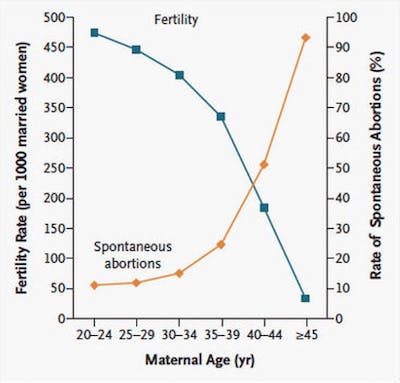
Here is some info on a woman’s fertility with age. This is literally the chance per month (menstrual cycle) that a woman is likely to get pregnant if she has sex.

As we can see, it is at its highest around age 20-22 (info on teen years seems to be stable at the highest levels), and then falls off. After about age 37, it collapses.

Chance of miscarriage:

Chance of infertility:

In practical terms, I think of a woman’s prime childbearing years as around age 18-25, a secondary but still high plateau around age 26-32, a quick decline during 33-40 and a few wisps and vapors after 40. Thus, if we are to follow Natural Law, we should aim for women to get married and have children around 18-25, with her last children perhaps coming around age 32. From this it follows that there is not really much need for college and working.

Natural Law and God’s Law

I am not a practicing Christian, but I am Christian-friendly. Christianity, and its related institutions or traditions, is basically the “operating system” by which Western Civilization runs. There are other good operating systems. iOS and Android are both pretty good. China uses Confucianism and Japan uses Buddhism. But, Christianity is the one that we use.

Since a lot of discussion these days is taking place among Christians, I think it is useful to translate some Christian concepts into forms that non-Christians can make more sense of.

An old idea in the West, which links government, science and religion, is the notion of Natural Law. I will try to summarize.

Today, we would probably say that “Natural Law” is a “Law of Nature.” For example, gravity, or thermodynamics. If you jump off a tall building, you will get hurt. If you put your hand on a hot stove, you will get burned. This is not hard to understand. But, if God Created the Universe, then certainly Natural Law is also God’s Law. It is God’s Law that, if you jump off a tall building, you will get hurt. Or, from this natural cause and effect, you can then create principles of behavior. God’s Law is: don’t jump off tall buildings, and don’t put your hand on hot stoves. Or, as we would wish God to be not quite so informal: Thou Shalt Not Jump From Tall Buildings, Nor Put Thy Hand On Hot Stoves.

This is not hard to understand in terms of the physical world. But, there is cause and effect also in human affairs. For example, people who do crystal meth usually come to harm. It is not quite as straightforward as jumping off a building, but the outcomes, at least in a statistical or actuarial sense, are almost as certain. This causes harm to themselves, and inevitably, to others around them — their family, their parents, their neighbors, their society. It is thus “immoral” — actions which cause harm to yourself and others. “Immoral” behavior is basically destructive/harmful action, and “moral” behavior is constructive/beneficial action. Lose/lose behavior is immoral. Win/lose behavior might be immoral, if the overall outcome is a net destructiveness — if the loss is more than the gain. Win/win behavior is moral.

Thus, you could say that God’s Law is: crystal meth use is destructive, and thus immoral, from which we get the principle, which could also be called God’s Law: Thou Shalt Not Do Crystal Meth. We can also get the real-world legal statute: crystal meth use/sale is a crime and comes with a criminal punishment. Some of God’s Laws are human laws — Thou Shalt Not Kill — and some do not seem to come with human sanction — Thou Shall Put No Other God Before Me.

Crystal meth use is not too hard to understand. We are generally in agreement regarding the causes and likely effects here (although people do it anyway). Premarital sex, or promiscuity, or adultery are cloudier issues. And yet here too, there are causes and effects. Some outcome pertains; and it seems like the consequences are vast, although hard to define in their totality. God’s Law is that there are effects that arise from these causes; and that these effects are generally destructive. From this we get rules of behavior: Thou Shalt Not Commit Adultery. However, to accurately analyze, understand and express these threads of cause and effect would challenge the brightest intellects of a generation. Even if they arrived at the right answer, for average and subaverage people to then make sense of it would be near impossible. Thus, people in general tend to rely upon “faith,” that God’s Law (principles based on cause and effect, with the intent of avoiding harm and producing positive outcomes) as it is expressed to them is correct, and they should follow these Laws without asking too many questions, or presuming that God’s Law is in error, and they have all the answers. Even if you look upon God’s Law as expressed in the Bible as a matter of cultural inheritance, the accumulated and refined wisdom of a hundred generations, four thousand years of human trial and error experimentation recorded in the form of anecdote rather than a message conveyed via burning bush from the Almighty, the outcome is much the same either way. If we do consider it direct communication from a higher intelligence, can we not say: good advice! There is cause and effect, from which we derive rules of behavior. Don’t jump off tall buildings, do crystal meth or commit adultery.

You can extend this even to the afterlife. It is pretty clear that God does not have a police force here on Earth, or a justice system. The punishments are in the nature of cause and effect. But, it is harder to say, for the Afterlife. You could say that the punishment for breaking God’s Law is that you won’t get into heaven. Sometimes this is seen as petty and arbitrary. For example, if God decrees that you must wear a blue hat on Wednesday, can we really imagine that we will be punished for such a thing? But what if, instead of arbitrary punishment, it is advice? Whether your version of Heaven is Christian or Hindu or Buddhist, commonly there is some kind of requirement to get there, which is basically to be “good.” Some kind of condition must be fulfilled to get off the “wheel of rebirth” or “samsara.” Only heavenly people get into heaven. In heaven, people only do things that bring good to others, not harm, and thus, the only people who are allowed in there are those who, on Earth, did things that created good, not harm. They were “moral.” God’s Law here is, again, cause and effect, but not only in our earthly world, but in the afterlife. You just aren’t going to qualify if you keep doing that stuff. Don’t say I didn’t warn you.

The New Age-y people will talk of “Service to Self” (“bad”) and “Service to Others” (“good”). On Earth, people eventually graduate to an incarnation in one of these other worlds when they polarize toward one or the other. (Reincarnation was regular doctrine of the Catholic Church until the mid-sixth century A.D.) By “polarize” I mean that: They become very good, or very bad. Then, they go to a place where everyone there is just like them. One is called “heaven” and the other, consisting of people who only cause harm to others for personal gain: “hell.” In Heaven, the pattern is cooperation for mutual benefit in an egalitarian society. In Hell, the strong enslave the weak.

Christians often look to the Bible for inspiration and instruction. You have to look somewhere, after all. Why not look to the Bible, instead of, say, Ovid or Danielle Steele?

Katherine’s Final Speech

Let’s enjoy the final speech of Katherine (the Shrew), from Shakespeare’s The Taming of the Shrew, as played so well by Elizabeth Taylor in the 1967 movie from the play.

But first, as background, here is Katherine as we first meet her. The meek and beautiful Bianca is Katherine’s younger sister:

Here, Petrucchio (tempted by a big cash payoff from Katherine’s father, who is eager to be rid of her), proposes to Katherine.

Katherine’s final speech. She is still the same powerful, dynamic, pushy woman (she literally throws Bianca to the floor), but what a wife!

Lonely Virgins

Men looking for wives in today’s swamp of party sluts looking for Captain Save-A-Ho and “good girls” ground down and worn out by a decade of “dating” might despair at the seeming lack of suitable women. But, actually, a CDC study found that 43% of senior high school girls were virgins in 2015, and this was actually up from 35% in 2009. A fairly large percentage of college girls (hard as it may be to believe) are also virgins. So, if you are aiming for the 16-25 range, there are still a lot of options even among those girls who are not necessarily pursuing a “no sex before marriage” strategy. I think that young women today have a vague sense that “dating” and “hookup culture” has become a meatgrinder from which few emerge with happy results, and they are pulling back a little bit. Still, they don’t know what else to do.

Nevertheless, only about 3% of women are virgins at marriage. So, it seems that premarital sex is part of the accepted path to marriage. This certainly creates problems for women: damned if you do, damned if you don’t.

Those women who have deliberately chosen to avoid premarital sex, and even premarital kissing (!), are a lonely bunch. It is not easy for a girl to say today: “No, you can’t kiss me, but you can marry me.” Men don’t know what to do with that. In the “dating for fun and sex without commitment” model, it is an instant dealbreaker.

The point here is: virtuous girls are rare today, but the men who want them are even rarer, so there is a relatively large amount of supply and not very much demand. Rather nice girls are getting no attention and languishing unmarried, and even unkissed. This is good for the man that is considering pursuing the Courtship Model to find a wife today.

Let’s meet a few of these girls.

Never been kissed at 19. Any man who is unmoved by her particular manner of gentle romantic coquettishness could probably use some testosterone injections.

Six years later …

Miss Universe competitor from Philippines says that she has never had a boyfriend. (Yes, I know but that’s what she says.)

Virgin at 32.

Never had a boyfriend.

Virgin at 31.

She’s 22.

Virgin at 29 (still at 37).

She “saved herself for marriage.”

Her too.

Lucky husband.

It’s not easy.

Lack Of Traditional Values Destroys Nations In Three Generations

Lori, at The Transformed Wife, ponders the idea that the “lack of traditional values destroys nations in three generations.”

Be sure to click the links.

Yesterday, our pastor said that an atheist man set out to figure out what destroys nations. His conclusion was that the leaving of morals (disintegration of family and unbound sexuality) is what destroys nations in three generations. We can see this happening in our nation.

How Gargantua Showeth That The Children Ought Not To Marry Without The Special Knowledge and Advice Of Their Fathers and Mothers

Gargantua and Pantagruel (1546), by Francois Rabelais.

Chapter 3.XLVIII.—How Gargantua showeth that the children ought not to marry without the special knowledge and advice of their fathers and mothers.

Could the Goths, the Scyths, or Massagets do a worse or more cruel act to any of the inhabitants of a hostile city, when, after the loss of many of their most considerable commanders, the expense of a great deal of money, and a long siege, they shall have stormed and taken it by a violent and impetuous assault? May not these fathers and mothers, think you, be sorrowful and heavy-hearted when they see an unknown fellow, a vagabond stranger, a barbarous lout, a rude cur, rotten, fleshless, putrified, scraggy, boily, botchy, poor, a forlorn caitiff and miserable sneak, by an open rapt snatch away before their own eyes their so fair, delicate, neat, well-behavioured, richly-provided-for and healthful daughters, on whose breeding and education they had spared no cost nor charges, by bringing them up in an honest discipline to all the honourable and virtuous employments becoming one of their sex descended of a noble parentage, hoping by those commendable and industrious means in an opportune and convenient time to bestow them on the worthy sons of their well-deserving neighbours and ancient friends, who had nourished, entertained, taught, instructed, and schooled their children with the same care and solicitude, to make them matches fit to attain to the felicity of a so happy marriage, that from them might issue an offspring and progeny no less heirs to the laudable endowments and exquisite qualifications of their parents, whom they every way resemble, than to their personal and real estates, movables, and inheritances? How doleful, trist, and plangorous would such a sight and pageantry prove unto them? You shall not need to think that the collachrymation of the Romans and their confederates at the decease of Germanicus Drusus was comparable to this lamentation of theirs? Neither would I have you to believe that the discomfort and anxiety of the Lacedaemonians, when the Greek Helen, by the perfidiousness of the adulterous Trojan, Paris, was privily stolen away out of their country, was greater or more pitiful than this ruthful and deplorable collugency of theirs? You may very well imagine that Ceres at the ravishment of her daughter Proserpina was not more attristed, sad, nor mournful than they. Trust me, and your own reason, that the loss of Osiris was not so regrettable to Isis, nor did Venus so deplore the death of Adonis, nor yet did Hercules so bewail the straying of Hylas, nor was the rapt of Polyxena more throbbingly resented and condoled by Priamus and Hecuba, than this aforesaid accident would be sympathetically bemoaned, grievous, ruthful, and anxious to the woefully desolate and disconsolate parents.

Teaching our daughters well is the early foundation of successful wife moulding — Σ Frame

Jack at SigmaFrame takes up the idea of how to train daughters (and sons) to become productive wives, husbands, and members of society.

This is very much in line with the themes for us here, which include:

1) Get Up Off Your Knees.
2) Get Your Patriarchy On.
3) Tell The Bitches What To Do.

Readership: Fathers; Parents; Grandparents; Christians; Introduction The author of Biblical Gender Roles made the following statements in a comment.* “From everything I have seen of Red Pill, it completely rejects a man appealing to a woman’s sense of duty and honor as if women are incapable of having any such sense. So according to the […]

Teaching our daughters well is the early foundation of successful wife moulding — Σ Frame

Egg Freezing is Fantasy

Women getting to about 35 and freezing their eggs has become popular. I think it is little more than fantasy and delusion. Upfront, the process has an official success rate of 14.8%. But, that even assumes that we successfully get to the point of actually wanting to unfreeze those eggs, for example by finding a man. Roosh (yes, him) recently summed things up on Twitter.

Women: if you get to the “freezing eggs” point, I suggest:

  1. Finding a husband pronto. Think “arranged marriage.”
  2. Get artificially inseminated and becoming a single mother.
  3. Stop using the Pill and don’t tell your boyfriend.
  4. Accept your fate and be a wonderful Aunt with plenty of time and money for travel.

You are out of time. You have one last chance to stop fantasizing.