Conservatives are often called the “brakes on the runaway Progressive train.” They slow down the process of degeneracy caused by Cultural Marxism, but don’t do much to repair it, or reverse the process.
Usually, “conservatives” regard whatever the norms of their youth were as “traditional.” When “dating” (premarital sex in monogamous relationships) became popular in the 1920s, it was considered degenerate compared to the “traditional” practice of Courtship. But, by the 1950s, “dating” (serial monogamy, although with marriage the assumed destination) was the norm. Today, people who grew up with “dating” in the 1950s and 1960s now consider that to be “traditional” or “conservative,” while Courtship is alien and forgotten. In the 1960s, cohabitation before marriage (“shacking up”) was considered degenerate. By the 1990s, when I was young, this had become the norm, although by the 1990s “serial monogamy” did not have the assumption of concluding in marriage, but was more often conceived as a stable state in itself. Hookup culture was spreading but had not become dominant. Today, a monogamous cohabiting young couple is considered to be fairly “traditional,” and on a likely path to formalizing what has effectively already become a marriage. It is getting a little hard today to even imagine a couple that would take the leap to marriage without cohabiting first. Cohabiting is not very compatible with hookups, long-term Friends With Benefits arrangements or polyamory, which is considered degenerate today but is on the now-well-worn path toward normalization.
Thus, the whole process has been one long slide of continuous degeneracy from the original model of Courtship, which proved to be stable and productive for centuries. Today, we can look back on this and say that it does not make much sense to try to recreate the norms of our youth (for me, serial monogamy or “dating” leading to cohabitation), as that was just a transient period in a long path of decay, which has no inherent advantages or evidence of long-term sustainability.
So, we are left with studying patterns that have not existed for about a century. There is nothing within living memory worth “conserving.” We have to build anew, from fresh materials.
I was once in a long conversation with a friend, who was the sole earner in a family of five (three daughters!) with a stay-at-home wife. This ranged over many topics, and was one of my early learning experiences regarding husband/wife relations.
Basically, he had a consistent problem (in my view, and I think he shared this view) of failing to be the leader of the family. Naturally, to keep the ship from running onto the rocks completely, the wife must step into the leadership role, and pretty soon regards her husband as incapable of leadership.
But, this was all very abstract. Finally, it came down to a single, practical topic: Control The Money.
I will highlight this here for those men who didn’t quite hear what I am saying: CONTROL THE MONEY.
When you control the money, you are pretty much the boss. Your wife can blah blah blah all goddamn day, but you CONTROL THE MONEY so you say what’s what, bitch. Since, in this case, he was the sole provider of said money, this was easy to do. Obviously it gets more difficult in a two-income family, which I will discuss at some other point.
What this means is:
The man makes all the major financial decisions. This probably includes:
The house The cars Major education expenses, such as private schools or colleges Other big “infrastructure” payments like health insurance or other forms of insurance Home renovations Vacations All intermittent big-dollar purchases like major appliances or furniture Savings and investment
Your wife can certainly be involved in this process. You can talk together for months about what kind of house you want, what neighborhood, and so forth. You can even delegate major responsibilities to her. You think we need a new sofa? Go find one you like, and show me. But, in the end, the man gives the thumbs up/thumbs down on the purchase, and writes the check, from the checking account that HE ALONE CONTROLS.
All of his employment income goes into this account. There is no “joint bank account.” He pays for the major expenses directly, including the home mortgage, taxes, and automobiles.
The wife typically gets a monthly budget, which takes care of a multitude of recurring monthly expenses, and childcare items. The man writes a check to his wife each month, and she deposits it in her account which SHE ALONE CONTROLS. The wife may argue that she should have more money, or less. But, in the end, the husband decides what she gets. This monthly budget covers things like groceries, gasoline, possibly monthly utility bills, minor children’s expenses like clothing and school supplies, and some fun money for her to buy nice clothes and go have lunch with her woman friends.
That’s it. Do this and you will be The Boss. Your wife might even get a little tingly as a result.
If courtship is difficult to imagine today, arranged marriage is so totally alien to us that it rarely even crosses people’s minds as a possibility. But — listen up, Disney Princess girls — it was the way actual princesses got married for centuries.
I mention this in respect to the difficulties of constructing a Traditional Courtship model today. If a woman isn’t going to go to college, or have a career, she really, really needs to find a husband. An arranged marriage is much easier to understand than courtship. Basically, parents find an appropriate husband for their daughters. (This implies the willingness of young men to also participate in the process, but I think that this is not necessarily such a big hurdle.) They do all the regular background work. Commonly, the young couple meets at some point, as the marriage is discussed. Mostly, this is a check to see if the proposed match meets some kind of minimum standards — not too fat, ugly or bad-mannered as to be inconceivable. But, often photographs are passed around beforehand anyway. In practice, there was some potential for overlap between an arranged marriage and courtship: an arranged pair could “court” for a month to see if there was compatibility. It is said that a woman decides within one minute whether she is going to sleep with a man. Maybe deciding whether a man is marriageable or not takes about the same amount of time.
Arranged marriages generally have a good track record of success. From the man’s point of view, if a man is interested in marriage (and many are), why not go for a beautiful, innocent young virgin bride, who, at your twenty-year wedding anniversary, is still going to be a sexy 38? And why struggle through all the difficulties of the dysfunctional dating/courtship process, perhaps over a period of years, when you can just raise your hand, say “OK, I’m ready, find me a girl,” and get matched up perhaps within a couple months?
In the era of Courtship (before 1920), young women generally lived at their father’s house until they were married. This produced a desirable wife — young, virginal, innocent, well-trained, well-cared-for, horny as heck and anxious for a home and husband of her own. But, a young man who lived at his father’s house was not exactly prime husband material.
There were some exceptions to this: In general, the eldest son would inherit the family farm/estate/business. As a young man, he would probably be “working” at the farm or business, in preparation to eventually taking it over. (Farming is hard work, and among the Amish today, men commonly step back from hard physical labor around age 50, leaving this to their sons.) These heirs could be desirable husbands, although they typically came with a lot of complications, in particular the mother-in-law who was often a tyrant to a young wife.
But, otherwise, a man would have to go out in the world and establish some kind of career. This took some time, and during that time, the man would often live alone. He might be traveling the world as a soldier, sailor or merchant. He might be moving from city to city, for business, or to build a career. When he got married, he was perhaps age 21-35, commonly 3-10 years older than his wife who married at age 16-25.
During this time, a man might gain some “experience” — that is, he was not a virgin at marriage. Usually this was not talked about much, and it was easiest to just make believe that he was a virgin like his wife. Also, it was, to some degree, a sign that the man was not a complete loser, and could make things happen in the world. A little dalliance was looked over, but debauchery (a “rake”) was not respected. As I noted earlier, it appears that the pair-bonding effect in men declines over a much longer period than for women. While the pair-bonding effect deteriorates with perhaps five partners for women, it takes thirty for men. Most men did not come anywhere near this figure before getting married, so their pair-bonding impulse was largely intact.
I have been enjoying this summary by Sigma Frame about the state of “courtship models” today. But, as I have said, I do not want to repeat this analysis, which has been very well done by others, nor particularly add to it, since I think we have mostly done enough by this point, and what has been done is mostly correct, or functional — not in error.
But, all of this has to be boiled down into some basic structures, or “things to do.” As I have said, it has to be something that a fourteen-year-old girl can understand, and put into practice — and get good results. The most recent attempt to do so, the “purity movement” of the 1990s and 2000s, ran into a surprising number of difficulties. Nevertheless, it was a noble and earnest attempt, which continues today in an evolving form. We should respect all those that participated. It is not easy to be pioneers.
I read the novels of the nineteenth century with interest, because it was the last time that “courtship” worked properly in the West. One of the things you notice is that there is no “dating.” Courting couples do not dress up and go to restaurants. From the highest levels of society (War and Peace) to the lowest (Little House on the Prairie, or Peggotty and Mr. Barkis in David Copperfield), nobody ever goes to a restaurant. They do not seem to exist.
The primary social interactions seem to be social events (particularly dances), and also, visits to a young woman at her father’s home. In practice, in small communities everybody tended to know everyone else from childhood, and would bump into each other while going about their business, or in church (this is perhaps one reason why people made such an effort to dress up for church). Among the leisure class, people made a constant stream of visits to each others’ houses. In those days, there was no television, recorded music, radio, internet, video games or social media. If you were tired of reading, there wasn’t much else to do but talk to your neighbors. People did not suffer from an excess of choice. Your future spouse probably grew up within forty miles of you.
Courtship was not supposed to be “for fun,” but it was supposed to be fun — that is, a woman and a man would enjoy spending time together. If a man showed a heightened level of interests in a woman, and they were understood to be “courting,” it was expected that the man would either propose to the girl, or get lost within a few months. If a woman was expecting a proposal from a man she liked, and planned to accept it, she might refuse the advances of other men during that time. If it turned out that the man was just fooling around and having fun (“having fun” here meaning spending some pleasant time together, probably without getting to the handholding stage), then he would be wasting the woman’s time and she might have turned down some other suitors that were more serious. This is actually a major plot device in some novels. If you were aiming to get married at age 18, you couldn’t dilly-dally with timewasters.
Nevertheless, “courting” was mostly supposed to be light and enjoyable, like “dating” today. Of course there was always the consideration of whether a person (the man, usually) was an appropriate match, but this happened in the background. The purpose of “courting” at all was to develop or explore some connection between the pair that went beyond their “courtship resumes.” It was also to develop the interest and motivation that would lead young people to make a commitment. It was about “soft” aspects — personality, character, physical appearance. If it was only about “courtship resumes,” then you could just have an arranged marriage and forget about “courtship.”
A lot of “courting” was done with the assistance of older adults, particularly a woman’s mother and her matronly friends. It became known that a young woman, or a young man, was serious about finding a spouse, and pretty soon the older women would be involved in matchmaking. This relied, in part, upon a community of older women, which was more common when women were housewives, and weren’t distracted by television. They spent a lot more time chatting together, under one pretense or another.
Courtship could be very brief. In Hermann and Dorothea (1797), by Johann Wolfgang von Goethe, a young man meets the woman of his interest for the first time in the morning. Her background is checked out by some older, wiser friends (a doctor and a priest) in the afternoon. He proposes to her (with some plot complications) that evening, and they are married before midnight.
At times, courtship could be extended for a very long time, but this was really “engagement,” not courtship. The promise to marry was already given (although it could be taken away). The most common reason was that the young man had good prospects (he was in law school for example) but was not yet ready to support a family. Or, perhaps there was some other complication, such as that the woman was in mourning for her father.
Marriage itself was not some drawn-out affair, as it often becomes today, with planning stretching over a year. Once the marriage is agreed to, it could take place three days later, and typically did not cost a lot of money.
Today, we generally do not have the social environment that was common at that time. It is hard to imagine “calling on a woman” at her father’s house today, if you are over the age of sixteen. We do not have the close-knit communities in which everyone knew everyone else. High school and college does create a community of this sort today, but the relationships that are formed there are, in many cases, assumed to be transient. Even among the working classes, who do not expect to go to college and who will probably live near where they went to high school, people today do not seem to find their spouses in high school, as many probably did in the 1950s. The upper classes do not spend their time visiting each other, as they once did. Social dancing, or other such events where some connection could be made between men and women, does not exist anymore. It is hard to imagine any kind of relationship with a woman one meets at a “dance club” today besides a hookup. The workplace serves as a major courting arena in some cultures today (notably Japan), was probably the place that many American men found their wives in 1900-1980, and which even in 1990 was the place that 20% of Americans found their spouses. But, that was down to 10% in 2005-2009, and given all the dangers of such activity today, is probably going to slide towards zero.
This brings us to “traditional dating,” as Thomas Umstattd suggested in Courtship in Crisis. Unfortunately, in the effort to break from “dating,” (premarital monogamous relationships including sex, or pre-sex — First, Second and Third Base — among the very young), many interested in courtship also eliminated dating, which is: going on dates. But, without the infrastructure of alternatives to dating, as a way for young people to spend some time together and make a connection, too often people are left with nothing at all.
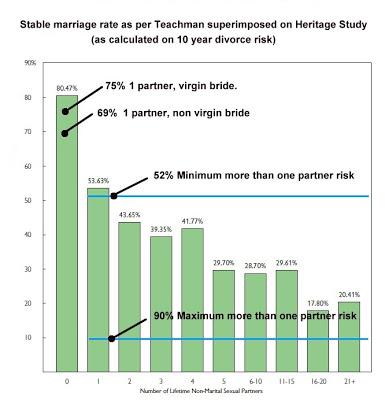
This is the probability of successful marriage (no divorce) after ten years, according to the number of previous sexual partners the woman has.
I read elsewhere that the hormones associated with pair-bonding in women decline over the first five sexual partners she has. The pair-bonding hormones in men decline gradually over thirty sexual partners. (I will have to find this data at some point.) The result is that premarital sex is far more damaging to women than to men. Also, it is far easier for a woman to engage in promiscuity than it is for men — even today, probably 80% of men have fewer than ten sexual partners at marriage, which means that their pair-bonding ability is largely intact at marriage. I would say that even men who were libertines are better able to stay married than women with a lot of sexual partners. Many men, at a certain age, seem able to give it up. Other men may still be unable (or unwilling) to resist temptation throughout their lives (Donald Trump? John F. Kennedy?), but this does not threaten their marriage and family.
As I see this, there is a big dropoff in marriage success rates for the first five partners a woman has, which I imagine is related to her impaired pair-bonding potential. After about five partners, there is a plateau, from about 6-15 partners. I interpret this as being capable of maintaining a monogamous relationship, but perhaps without the emotional bonding, as more of a business relationship — which lasts as long as it is good for business. After 15-20 partners, a woman tends to become incapable of maintaining a monogamous relationship, even if she perhaps imagined that she would when she got married, and even if it would be in her best interests to do so. The lure of temptation/hypergamy, the feeling of boring absence after years spent in pursuit of quick thrills, pulls her back to her old ruts. There was a recent movie about this, What’s Your Number. In it, a woman reads in a women’s magazine that a woman with more than twenty sexual partners becomes unfit for marriage and family.
Naturally, from this we can guess why a woman who is a virgin at marriage has been so highly prized throughout history, in virtually every major sophisticated civilization and religious tradition. Much leads from this, including a tendency for women to marry young — around age 18-20.
Unfortunately, some statistics on marriage are hard to interpret. For example, if everyone got married at age 26, then the “percentage of people age 20-30 who are married” would be 50%. This is a better site for understanding when people get married, or got married in 2010-2015, the period of data collection.
Basically, 48% of men (all races) were married at age 30, and 60% of women. For whites, 58% were married at age 30. Unfortunately, the widget does not seem capable of breaking out both gender and race.
One thing that the Church, and young Christians need the most these days, is a trustworthy path towards a solid marriage. Right now, young people are forced to play by the world’s playbook if they ever hope to establish any type of relationship with the opposite sex. The Church should be offering an alternative, but our current leaders of established religion are not taking sufficient action towards developing a working, God honoring model of courtship to be institutionalized.
The present system, which is little more than an informally institutionalized cuck generator, would probably have continued on indefinitely, but then along comes those Christian Manospherians, Dalrock, Donal Graeme, Zippy Catholic, et al., throwing a monkey wrench into Fe-Mini-Satan’s machine.
But we’re not quite there yet. The problem has been starkly revealed, but there has been little progress towards formulating any alternative models. Among those speaking out against this plague, they’re telling us what Courtship is not, and not what Courtship is. So many readers are yet dissatisfied with RP progress.
Those who are not active Christians (like myself) may be somewhat dismayed that even here there is mostly confusion. I look forward to seeing how far they have come.
The Good Wife Level 5 understands that, from her kitchen table, she works the raw material of civilization and culture. Every act, for her, takes on significance for the evolution of society, of the nation, and for humanity as a whole. This includes even drinking coffee — or perhaps she should not drink coffee? What if, following her example and leadership, eventually, nobody drank coffee? Or, could we develop this mundane thing, drinking coffee, into a nexus of cultural sophistication, as the Japanese once did for making tea? Shall we build a coffeehouse in the backyard? This is wifery on a planetary scale.
For the Good Wife Level 5, the significance of all her actions goes beyond her family to the broader community of like-minded people. If she, for example, researches the negative effects of vaccines, she does not do so only for herself, but for others as well. She spends time researching the topic, and then communicates the results of her research so that others can learn what she has learned with far less effort, or so that people can understand the great significance, and consequences, of something that most people do without thinking about it much. Or, she discusses these topics with a community of interested people, learning from their experience and expertise. She almost certainly has a blog, a podcast, a YouTube channel, or maybe a series of books — the subjects of which are, simply, the the things that come up within the context of her own family. These are of seemingly unlimited depth and importance, and can easily engage the most brilliant minds and most industrious characters to the limits of human potential.
Probably no mortal human could excel in all the aspects of housewifery that we list here, as there are not so many hours in the day, so the real-world Good Wife Level 5 probably has a few areas of specialty, and other areas where she is more of a Level 3, Level 2 or even Level 1 wife. Nevertheless, over a period of perhaps twenty years, quite a lot can be accomplished by the woman who continues to explore all the aspects and ramifications of her household duties.
Some examples of the Good Wife Level 5 include:
Julia Child: Got interested in French cooking; taught a generation of women how to move beyond meatloaf, hamburgers and macaroni and cheese. Married at age 24, but childless.
Phyllis Schlafly: Expounded her traditional-housewife ideals upon the national stage, and into public policy. Wrote 26 books. Married at age 25. Six children.
Helen Andelin: Married in college. Found womanhood fascinating, and told millions of women how to do it right. Mother of eight children.
Rachel DeMille: Co-created, with her husband, an ambitious model of homeschooling followed by tens of thousands of families. Established the Colesville Academy and Young Statesman’s Society. Mother of eight children.
While these ladies are in the Olympic Pantheon of Level 5 housewifery, there are a number of women who show a lot of promise today. One of them is Rebecca from Blonde in the Belly of the Beast, who is an 8/10 for looks, a 10/10 for brains, and also has the good sense to get married and get pregnant before age 30.
Then there is Christy0Misty, who, when she first appeared a decade ago, was like a talking horse: so many men had never even seen a woman like this. Now she is a mother of five. She had a great run as an “anti-feminist,” but hasn’t quite hit her stride yet with her motherhood channel.
While the Good Wife Level 2 and 3 participates in community organizations, and the Good Wife Level 4 perhaps withdraws from such mainstream institutions to go her own way, the Good Wife Level 5 sees certain needs and opportunities, sees the advantages that can come from group cooperation, and creates new institutions. If she sees a need for her daughter to find a good man to marry and no obvious means or method to meet such men, the Good Wife Level 5 might establish a new club or organization where marriage-minded singles can get to know each other. This could be a ballroom dance series, or a church group. Her homeschool efforts may expand to other children, and she opens an academy.
While the Level 4 woman works out and looks good, the Level 5 woman works out, looks good, and then uses this as the basis to change the lives of tens of thousands of other people. Maria Kang, mother of three, took a picture of herself with her children that was somehow so provocative that it both got her banned from Facebook, and on the cover of Shape magazine. Her noexcusemom.com free online community now has 176,000 members in 361 “in real life” meetup groups in 24 countries. Five years later, she looks like she is still making her husband very happy.
Nobody can expect to get so much mileage out of a single post on Facebook, but the Level 5 woman is content with her hundred followers on Twitter, or the five women in her formal or informal in-real-life community group.
Since we are talking about the Good Wife Level 5 here, of course her sex life is the stuff of legend. She is not horny all the time, does not have an “insatiable sexual appetite,” and is not interested in sex with men (or women) other than her husband. Kinky and deviant things she regards as a sign of dysfunction, for people who, for some reason, can’t enjoy things the normal way. She is normally quite modest, and careful not to attract the attention of other men with suggestive dress or coquettish behavior. Other men notice anyway, and regard her with a kind of respectful admiration. Sex is not always such a big affair, because that would become silly. But, from time to time, she and her husband enjoy a long session of lovemaking, where she will have a dozen or more orgasms over the course of an hour or longer — she can never keep count. And since (as mentioned earlier) she has a bangin’ hot body (for her age), this is quite a lot of fun for her husband, who hardly has any interest in other women, who he knows could hardly be any better and very likely much worse. With the help of “wife goggles,” her husband considers his wife very sexy well into her forties and even fifties. Her husband too, knowing that sex is a shared endeavor and that he has to keep up his end of the deal, keeps himself in shape and polishes his lovemaking skills. If you asked the Good Wife Level 5 what she attributes her bedroom success to, she would insist it is her husband’s extraordinary ability and inherent natural sexiness, since he does the work and she mostly just rolls her eyes back and goes along for the ride. If you asked the husband, he would certainly give credit to his wife, since he is not doing anything else than any other man might do, but he is getting much better results. The Good Wife Level 5 read on the internet somewhere that 75% of women report that they rarely or never achieve orgasm during vaginal intercourse, but she regards this as ridiculous and inconceivable. She might get interested in sex as a realm of exploration and study, just as she is interested in all the other aspects of her life. She has her favorite parts of the Kama Sutra. She might get involved in Tantric sex practices, and not in a dilettantish way either. This would require the participation of her husband, who would also join her on this journey, as any man would who is not a damn fool.
In most ways, the Level 5 Wife is much like the Level 4. But her personality, and her urge to express her experience, cannot be contained only within her living room, and bursts forth into the community and the world.
In traditional courtship, as practiced in the West until about 1920, and also as practiced most everywhere else as well, not only is there no sex before marriage, but there is not much of anything else, either. No kissing above the wrist.
When the husband kissed the bride at the wedding ceremony, it was, ideally, literally their first kiss.
If you read the novels of the nineteenth century, as I have been doing recently, virtually all of them (especially those written in English) have courtship (getting married) as a major plot element, at times nearly the only plot element. Jane Austen, who focused on this entirely, characterizes the pattern.
You would think that the first kiss, if it was a normal, institutionalized sort of thing, would be a big dramatic moment, as it is in old-fashioned Hollywood movies or cheap romance novels. But, this is never mentioned.
This contrasts with a common condition today, where women who are supposedly “saving themselves for marriage” will do just about everything one can do, potentially even “going to fifth base,” excepting vaginal penetration. Which is, actually, a normal outcome once a couple begins kissing. Also, a lot of the hormonal bonding and other “brain chemical” reactions that take place during sex, also take place during these kinds of foreplay activities, even if in a less intense manner. The result is that a girl is, hormonally speaking, in a pseudo-marriage. She is “going steady,” and if she breaks up with her boyfriend, she experiences similar trauma. This reaction is why the first kiss is important.
If this seems extreme, remember that it was matched by the fact that a lot of women got married at age 18. Courtship was not something that you drew out over fifteen years. It was something that you did once in your life, and it didn’t take that long. At age 19, these women were getting more dick than even slutty girls today, because, when you are sleeping together in the same bed every night, and you are nineteen years old, it just happens.

 Cornerstone