No Boyfriends

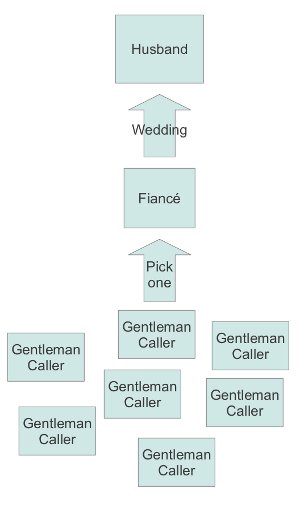
In Traditional Courtship, there are no boyfriends. That is a new invention of “dating.” It seems that there are a number of women with a “no sex before marriage” approach that nevertheless have boyfriends. This is not Traditional Courtship, it is “dating” arrested at the 13-year-old level. A woman has suitors; perhaps, preferred suitors; a fiance and a husband. In the time before a proposal, a couple may spend a lot of time together, but they are still not a “pair” yet. They are discussing that. In any case, the process is not drawn out. A man either makes a proposal or he leaves. There is no reason to spend more than about three months at it. In the past, people sometimes did have extended engagements, typically because the man was not ready to support a family yet, but it was expected that he would be soon. (Perhaps he is in law school.)

from Dalrock:

Having a “boyfriend” is not Courtship. Rather, it is when the Courtship process is put on hold, indefinitely. Women got married young because they didn’t waste any time with “boyfriends.”

Go to 4:55.

Courtship wasn’t for fun. It may be fun, but it wasn’t for fun. It was for finding a spouse. If a man was doing it for fun, simply to spend a pleasant afternoon with a pretty girl with no interest in marrying (her or anyone else), then he was wasting her time, and was to be shooed away.

Now, to state the obvious since it seems most people will do it the wrong way, Traditional Courtship is not the Feminist Life Script (school, job, get married around 30), without kissing or boyfriends. You didn’t need a boyfriend because you had a husband — typically around age 20.

Submissive Wives

Lori Alexander of The Transformed Wife is a good example of the “submissive” wife. Go there for lots of detail. But, I want to summarize basic principles.

The word “submit” or “submissive,” in the Bible when referring to wives, is derived from a Greek word, that is in turn derived from a Latin Roman term that refers to the relationship of a soldier to his commanding officer. Today, this is similar to the relationship of an employee to his superior. To “submit” is to arrange oneself into a relationship of subordination necessary to work together as a team. The team exists to achieve certain goals (winning the battle, winning the game, competing in business) and cannot be in conflict with itself. Thus, even though there are inevitably differences of opinion regarding the direction of the team/organization, the participants work together to achieve the goal.

Unfortunately, in English the term “submit” or “submissive” also refers to the relationship between, for example, the conqueror and the conquered, or a tyrannical government over its citizens, or a master to a slave. This leads to some distaste for the concept.

It is usually easiest for us today to imagine the employee/superior (“boss”) relationship, rather than a soldier/commanding officer relationship.

In a marriage, the man must be in the superior role, because a woman will soon become disgusted with a man that puts himself in the inferior position (who “submits” to his wife’s will). Women are happiest when the man takes the lead, and men are happy with this too. It doesn’t work the other way around.

Matriarchy does not exist.

In other words, a woman “enters a man’s Frame.” The man sets the order, and the woman works within it.

This superior/subordinate relationship can have many gradations. We can imagine some women who might be content with a man that seems “much higher than her,” for example like a general compared to the common soldier. This woman might prefer that the man take care of all the big stuff, so that she can basically have a comfortable lifestyle without worrying about all the details (mostly money-related), or participating much in the decision-making process. The man creates a sanctuary with a large buffer between her and the outside world, where she can focus on her narrow sphere of responsibilities and actions, mostly concerned with childcare, education, housekeeping, aesthetic interests (beauty, clothing) and socializing with her woman friends. Many women are very happy with this.

You could have a different sort of relationship, which is more like that of a CEO with his top vice-presidents, or a general with his top corporals. Here, the CEO might have an extended council about major issues, and delegate large responsibilities to his vice-presidents. This looks more like a “partnership,” but the CEO always has the deciding vote. In the end, the CEO makes the decisions, and the vice-presidents must work within that Frame without conflict. They must be an effective team.

You can’t be a “strong, independent woman” within a marriage. You can be strong (that is, highly capable), but not independent. When you join a football team, you have to play football. You have to play a certain position, and you have to cooperate with the team leader (quarterback, coach). When the play is a running play, specifically Play DD-37, you do not just go and do your own thing “independently.” Nor do you stamp your foot and insist on getting your way. If you don’t want to be on the team, then go somewhere else and be “strong and independent” independently. I suggest artificial insemination.

A husband can certainly take into account a woman’s desires and wishes. Her contentment is one of his responsibilities. If a wife says: “I want to take some tennis lessons because I think it would be fun and a good way to stay in shape,” then a husband can agree with that proposition, and make it part of His Frame. He might get a tanned, hardbody wife out of the deal. On the other hand, he may decide that she has been slacking off too much already, and has been falling short of his vision of how he wants childcare duties to be addressed, and thus refuse the request. Either way, the husband decides.

From this, we can see that it is necessary for a wife to “submit” — to join the man’s Team. Otherwise, all you have is internal conflict, or the disgust of the woman to the man who refuses to play the role of the leader.

The Stay-At-Home-Daughters Movement

Traditional Courtship is not just “Dating” without sex. For one thing, the Feminist Life Script (get a college degree, get married around 28-30) doesn’t make much sense when you take the premarital sex out of it. That’s why people never did it that way, except for a few leftover spinsters.

Apparently, there is a “Stay At Home Daughters Movement,” which revives one of the elements of Traditional Courtship — young women live at their father’s house until marriage. Often, in better families, they would continue their education at home. These days, you aren’t going to get much of an education at a university anyway, including Princeton and Harvard, so if you are going to learn anything at all it is likely to be on your own time.

Time Magazine on the Stay At Home Daughters Movement

Wikipedia on the Stay At Home Daughters Movement

I will have more to say later about how a Stay At Home Daughter might educate herself. But, the basics are:

Read the Harvard Classics. All of them.

Read the top 20 or so pre-1910 novels

Among other things, these daughters will learn about Traditional Courtship, which is important since they have no living examples.

Now, to restate the obvious, the goal of a stay-at-home daughter is not to stay at home. The goal of a stay-at-home daughter is to get the heck out of your father’s house, by marrying a man.

Get Up Off Your Ass

This message is for: men.

Waaaah waaah waaaaah. The Manosphere these days is worse than a roomful of bitches. We know, basically, what the problems are, as explored in great detail by the MGTOW people:

  1. Laws and legal standing of men.
  2. Women’s behavior, influenced by the laws.

Remember Dalrock’s definition of Feminism:

Dalrock’s Law of Feminism: Feminism is the assertion that men are evil and naturally want to harm women, followed by pleas to men to solve all of women’s problems.

And what do MGTOW people do today?

MGTOWism is the assertion that women are evil and naturally want to harm men, followed by pleas to women to solve all of men’s problems.

Mostly, this takes the form of pleas that women should change the laws, or at least, help change the laws. Along with that, we can add the treatment of men in organizations (corporations, universities) which are institutional policy, the “laws” of the institution, if not exactly legal statue.

This is not an unreasonable reaction. First, men are simply accustomed to feminism, having been stewed in it all their lives, so they fall into these patterns naturally. Second, it is clear that feminist groups (women) have had a lot of influence on institutions and also actual legal statute, in part because they constitute at least 50% of the vote, and when you add the Manginas, White Knights and Male Feminists you tend to get a majority.

But, that is not what we do around here. Remember our principles:

  1. Get up off your knees.
  2. Get your Patriarchy on.
  3. Tell the bitches what to do.

I think it is worthwhile to recognize that the common Feminist approach actually acknowledges, or assumes, Patriarchy. It is the typical behavior of a wife to a patriarchal husband. They complain and then ask the husband to make it better for them. Because, the Patriarch has the control and command. Wives moan to their husbands to make it better for them, but husbands do not moan to their wives to make it better for them. Nope. The man is on his own. He has to fix it himself. These are the responsibilities of leadership.

If a man actually does whine to his wife, and begs her to make it better for him, and (seething with disgust) she actually does so, I can guarantee that the man will not be happy with the outcome. Remember, Matriarchy Does Not Exist.

Today, “Patriarchy” is distributed, in the form of democratic Republicanism. (We can lament, perhaps, the fact that women are allowed to vote.) Thus, men have to act collectively to get things done.

We today have a Very Big Problem with failing to Get Up Off Our Ass and act collectively. This means big, big, big groups of people. On the Conservative side, the National Rifle Association is a good example of a highly effective, well-funded, broadly-supported institution that aims to achieve certain policy goals. Men’s Rights issues (issues regarding the legal standing of men, such as in family court, or regarding domestic violence or “sexual harassment”) need a similar, Big Fat Pushy organization, or several. The NRA had about 5.5 million members giving $170 million in funding in 2018, mostly from small contributors giving less than $100 each.

Leading Men’s Rights organizations should be similar: with ten-million-plus members, and funding in excess of $200 million per year (which is only $20 per person for ten million people).

We have a major problem today of men who want to sit on their ass and complain, but don’t want to do anything even so minor as giving $25 to some existing Men’s Rights organization that is actually working in their interest to fix those problems. More broadly, this is known as “self-government.” If people are incapable of self-government, then someone will step up and govern for them. You won’t like that one bit, I guarantee.

Fabius Maximus has had many excellent comments on this topic.

January 8, 2020: Films Show Our Problems And Why We Can’t Solve Them

So, today, we begin the process of building up the NRA of MRA. We can complain that the present Men’s Rights Advocate groups are sickly and ineffective, or are perhaps missing some important points or going in the wrong direction. But, a big pile of money would help solve that. And, if they did not put this money to use effectively, then some other person could step up and make the argument about how they will get things done much better. But, that other person is not going to step up if even the existing organizations can barely pay the electric bill.

So, our assignment today is:

  1. Give $25 to the politically-active Men’s Rights organization of your choice.
  2. Give $25 to the YouTuber, blogger, or other intellectual leader who best represents your interests.
  3. Write a letter to your State Assemblyman and State Senator (as appropriate) describing your grievances and what changes you would like to see to State laws.

It doesn’t really matter if you may think these people are somewhat mediocre, or not quite something that you are excited about. The important thing is that You Got Up Off Your Ass. You have set the example for other men to get up off their asses too. You have put some money in motion. Later, as you learn more about various organizations and what they do, maybe you will find a better recipient for your money. But, send some money now, and leave that research for the next time.

Now, to make this clear, I mean Really Sending Some Money, not just thinking about the idea of sending some money, and Doing It Now. You can also send more later, but send some now, even if you are not quite sure what you are doing. This is mostly for your benefit, to practice becoming politically influential by teaming up into large, effective, well-funded groups. Getting Up Off Your Ass is not the whole process of getting to your destination, but it is always the first step.

Today, I will recommend only one group active in public policy: the National Coalition for Men (ncfm.org). Go there and give them money.

Among bloggers/intellectuals involved in these matters, I suggest:

Paul Elam (avoiceformen.com, paulelam.com)

Warren Farrell (warrenfarrell.com)

Coach Greg Adams (youtube)

Sandman (youtube)

No doubt you can name some that are more to your liking. Just pick one and give them money.

The last assignment is to write to your State Representative and Senator (both). Most family law is State law, not Federal law, so it is determined at the State level. Your State Congressmen are very easy to access and are glad to hear from you. The Massachusetts State House of Representatives has 160 members, among a population of 6.9 million, or 43,000 people per State Congressman on average. Plus, he is always nearby, in-State. The average Federal Congressman has over 700,000 constituents, and also, he spends half his time in Washington DC.

Find out your local State Representative, and write him a letter. It can be a short letter, simply stating your stance. (“I am against no-fault divorce.”) You can write something longer, with reasoning and statistics. Remember, you might know a lot more about it than him, so explain what you know. It is easy to put graphs and pictures into a letter these days. Or, you could refer to a book that you feel represents your position.

I write letters to my State Representative and Senator from time to time. They have always written a personalized letter back to me, referring to the topic in question, their stance, and how they voted on the issue.
Working Out, Advanced Version

Doing a daily exercise program is a great way to get in shape. But sometimes ambitions rise higher than this. In the past, a young woman was expected not only to be slim and beautiful, but to have poise, grace and elegance. Among the upper classes, this was often achieved through the study of ballet. Let’s take a look:

This is a very high standard of student dance, and is probably best considered early training as a professional dancer rather than part of a regular upper-middle-class education. Nevertheless, we are now moving well beyond doing squats and pushups, to a very elevated milieu of physical performance.

Young men would be engaged in sports. Like sports, dance can be competitive, and requires the refinement of high-level skills over a period of years. It exercises teamwork and social skills. However, unlike sports, it is not inherently combatitive.

Amateur ballet performances are interesting, because they are often full of beautiful women in the audience — typically, mothers who also danced when they were younger. As an example of what I mean by “poise, grace and elegance,” here is an interview with Svetlana Zakharova, one of the finest dancers of her time. Compare her aspect with that of her interviewer.

She was forty years old in this video — and with an eight-year-old daughter, she too is a Ballet Mom. Here is Zakharova clotheshorsing it for Vogue Italy in 2014 — age 35:

Here she is on the job:

The “Purity” Movement

I was not a participant in the “purity” movement and have learned about it only after-the-fact and second-hand. Nevertheless, as the biggest recent movement to revive Traditional Courtship, it deserves close scrutiny. By the accounts of those that participated, it was somewhat troubled and problematic.

As I have mentioned, for the last several years I have been in a long review of the big nineteenth century novels. This has been fruitful in many ways, and one of them is to examine the courtship process of that time “from the inside,” from the standpoint of participants, even if fictional representations. From this I think it has become easier to identify where the modern “purity” movement, and other no-sex-before-marriage strategies, have differed from that successful pre-1920 pattern.

I mentioned earlier the book Courtship in Crisis: The Case for Traditional Dating (2015), by Thomas Umstaddt. Umstaddt was in fact an eager participant in the Purity Movement, and came away disappointed enough that he wrote a book proposing modifications to it.

We also have this recent and insightful post about related topics from Sigma Frame:

2020-01-17: The Sin of Prioritizing Purity Above Marriage

Let us leave aside for now the difficulties with marriage (and divorce) today following the wedding ceremony. We will consider “courtship” to be limited to the process of getting to the wedding day. Basically, both young women and young men, both participants in the Purity Movement and excellent prospective spouses, did not end up getting married to each other.

I will try to summarize some points where things seem to have gone awry. (Those who are more familiar with the matter may correct me.)

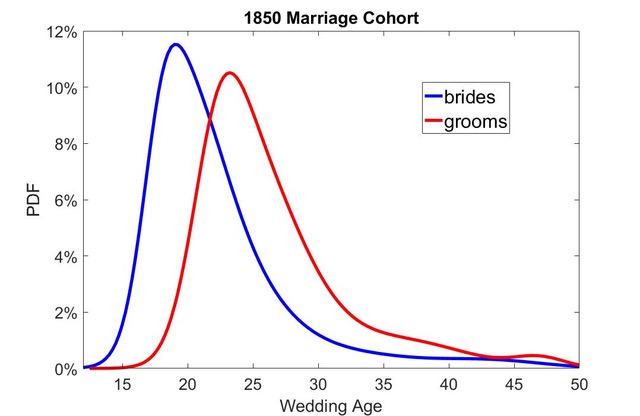
Maintaining the Feminist Life Script: In Courtship, in the pre-1920 era, women married young. 18-20 was the prime window, with 16-25 the practical range. Women did not have to do anything besides become wives — essentially, stay-at-home wives (although the division between work and home was not as great in those days). After marrying young, they typically had children quickly, and thus, within a year or two of the wedding, they were up to their neck in childcare duties — big adult responsibilities. More recently, the idea of “no sex before marriage” has been maintained, but this “no sex” period has been extended to the 28-30 period, which bypasses nearly the entirety of a woman’s fertility peak, and also, is far too grueling for any mortal woman to be expected to endure.

To get married at 18, a woman might be generating interest among potential suitors (typically the men in her neighborhood) from the age of 14. Today, any such attraction is assumed to be transient, since the woman is to leave and go to college. Then, any attraction at college is assumed to be transient, since the woman is assumed to be moving on to some sort of career. When a woman is finally “ready” to look for a husband around age 28, she finds herself in an atomized community where the men she meets are most likely complete strangers.

An overemphasis on “purity.” The purpose of courtship was to get married, since women really didn’t have anything else to do but either a) get married; or b) coast along quietly living at her father’s house. Unmarried older women (over 30) often became part of the households of their brothers, or ended up taking care of their parents in their old age. Most women got married, and they did it before age 23. Of course they wanted to maintain “purity” until their wedding day, but it wasn’t that long a time — in fact, many women make it to twenty today without losing their virginity, even when that was not any kind of rational plan. Unfortunately, the focus of the “purity movement” often became to maintain a woman’s “purity,” even to the point of shooing away the attention of high-quality male suitors (the male participants in the Purity Movement).

Fathers marrying their daughters. It seems like there was a tendency for fathers to place a marriage-like claim of ownership upon their daughters. This extended to the point of “purity rings” that were indistiguishable from wedding rings from a distance, and were worn on the same finger (left hand ring finger) as wedding rings. Apparently there were also “purity dances” where fathers danced with their daughters. I think there can be a purpose served by a “purity ring” worn on a different finger (for example right hand) that indicates: “I am following the rules of Courtship, which means No Sex and also I Want To Get Married.” Also, in the pre-1920 Courtship era, fathers really did go to dances with their daughters, but they didn’t dance with them.

Ridiculous standards for suitors. Related to all the above, fathers often had “standards” for suitors that tended to exclude nearly all potential real-life suitors. This was probably related to “fathers marrying their daughters,” and also, the “feminist life script” in the sense that, for a young man to marry his daughter at an inappropriate time, and to thus deviate from the feminist life script — to get married while in college for example — he had to be extra special. Also, it seems there was a sense that a suitor should be the sort of man who might be an ideal suitor when a woman was at the standard “feminist life script” age for marriage, around 28-30: in other words, a successful man of 30-35. If a woman was 20, and a man was 23, this 23-year-old man was expected to have the accomplishments of a 33-year old man. At the same time, an actual 33-year-old man would be considered uncomfortably old for a 20-year-old woman, thus disqualifying everybody. Lastly, it seems that fathers’ ambition in courtship is a longstanding theme: in Don Quixote Book II, Sancho Panza wants to marry his daughter (a commoner) to a nobleman, which is nice but not very likely. Panza’s wife argues that “you should just take the boy next door, wipe his nose, and have your daughter marry him.”

Lack of social infrastructure: Women probably met their future husbands just because they lived in the same town, and, in those days, you knew all the people in your town, and not many outside your town. Nobody was a stranger. Today, where people might be near-strangers, we have a need for “warmup” stages, corresponding to “let’s have coffee together.” Also, people did things in those days — visiting girls at their fathers’ house, and social dances — which we do not do today, and have no ready substitute for.

Girls who really wanted to be sluts: Unfortunately, most teenagers want to be like all the other teenagers, and most teenagers these days are slutty. Many girls probably did not really want to take part in the purity movement — and not surprisingly, since it apparently amounted to crossing the Sahara Desert of sex, a marathon of abstinence from ages 15-28. Related to this are those girls who may have actually avoided vaginal penetration, but did every other imaginable thing. In the pre-1920 period of Courtship, nineteen-year-old girls and their husbands were being fruitful and multiplying, which means: fucking like weasels, without contraception. Courtship and marriage in those days was a path to getting sex, not avoiding it.

Uncomfortable relationship with “dating”: There is “dating,” which is: premarital sex in serial monogamy; and there is dating, which is: going on dates. Since going on dates is one of the primary ways that women and men interact — in the absence of “visiting,” social dancing, and also, daily interaction arising from a close-knit community — by avoiding “dating” and its customs (going on dates), people often were left with no method of courting at all. This gave rise to the interest in “Traditional Dating.”

Women living alone: If there is anything more trying and difficult than remaining celibate throughout nearly the entirety of a woman’s natural period of childbearing, it is doing so not while living under supervision at her father’s house, but living as a single woman in a sex-addled society. That is too much temptation for anyone to be expected to bear.

We should respect all those who participated in the Purity Movement, who had the guts to make the world anew, and who gambled with their lives to do it. It is not easy to be a pioneer. We today build upon what they accomplished.

Women’s Logic

I am not really qualified to talk authoritatively about trends in Christian circles, since I know very little about them, but from a distance I get clues about dysfunctional patterns common today, among those that are attempting to apply a Courtship Model. Among them is the notion of “not settling,” or waiting for “God’s best.”

Women, in general, prefer the top 20% of men in terms of attractiveness, wealth, status etc. Nothing wrong with that. Let me tell you a secret — men also like the top 20% of women. But men are willing to accept women who are not in this top bracket. I would even say that men seek a certain amount of hypogamy, which is to say, a woman that is going to follow his leadership, and not cause a lot of trouble.

In monogamy, the top 20% of men are generally paired with the top 20% of women, and so on down the line, and everyone gets what they deserve more-or-less. However, in “hookup culture,” “dating” or “polyamory,” the top 20% of men can service 80% of women, even if perhaps on a rotating basis (one of a series of “serial monogamy” relationships). Women can want the top 20%, and actually get them, but only for a little while. Here women have to “settle” in the form of: not getting any commitment/investment from these men.

This produces the pattern of “not settling” among women today. They think they can get these top 20% of men, because they can indeed get sex from them, but the only reason they can get sex from them is because they can’t get commitment (marriage) from them. Unfortunately, this pattern has been embraced among Christian women who are avoiding sex before marriage. Not only that, they declare that it is “God’s will” that they not settle! They say that they deserve “God’s Best.” Let’s say that means: the top 5% of men. Did they ever think that, maaaaaaybe, 100% of the women can’t have 5% of the men?

It appears that, over a period of at least two decades, they did not ever think of that.

Normally, in Courtship as it existed before 1920, women married young, and they settled. At least they were smart enough to take what they could get when they could get the most — when they were at their peak of fertility and attractiveness.

For most women, the “season of singleness” lasted from about 15 to about 21, which was plenty long enough when you have itchy panties like any healthy girl of 17.

One such woman is Allyson Rowe, who really does deserve God’s Best (a top 5% man) considering that she is both (I hope) a debt-free virgin without tattoos, and also, former Miss Washington. If Allyson Rowe is still waiting around, and waiting, and waiting, you aren’t doing it right honey. Nor should you necessarily take her advice. A 10/10 girl can have standards that won’t work for average women. (Wikipedia lists her age as 25 when she competed in 2014.)

Dalrock had several excellent posts on this topic.

7/3/2017: A very long season part 1
7/10/2017: A very long season part 2
6/1/2019: She wasn’t God’s best
5/1/2019: The season of singleness

But with this, I want to point out how, during the last fifteen years or so, we have had some extraordinary feats of analysis and insight from the Manosphere, while it seems like women still can’t figure out that you can’t marry 5% of the men to 100% of the women. Or, to put it another way: Matriarchy does not exist.

But also, since it is time now to make fun of men whose actions are often equally stupid: please go and snatch up these jewels, rather than marrying some worn-out hoebag who is waving her boobs in your face.

Women’s Fertility

Here is some info on a woman’s fertility with age. This is literally the chance per month (menstrual cycle) that a woman is likely to get pregnant if she has sex.

As we can see, it is at its highest around age 20-22 (info on teen years seems to be stable at the highest levels), and then falls off. After about age 37, it collapses.

Chance of miscarriage:

Chance of infertility:

In practical terms, I think of a woman’s prime childbearing years as around age 18-25, a secondary but still high plateau around age 26-32, a quick decline during 33-40 and a few wisps and vapors after 40. Thus, if we are to follow Natural Law, we should aim for women to get married and have children around 18-25, with her last children perhaps coming around age 32. From this it follows that there is not really much need for college and working.

Natural Law and God’s Law

I am not a practicing Christian, but I am Christian-friendly. Christianity, and its related institutions or traditions, is basically the “operating system” by which Western Civilization runs. There are other good operating systems. iOS and Android are both pretty good. China uses Confucianism and Japan uses Buddhism. But, Christianity is the one that we use.

Since a lot of discussion these days is taking place among Christians, I think it is useful to translate some Christian concepts into forms that non-Christians can make more sense of.

An old idea in the West, which links government, science and religion, is the notion of Natural Law. I will try to summarize.

Today, we would probably say that “Natural Law” is a “Law of Nature.” For example, gravity, or thermodynamics. If you jump off a tall building, you will get hurt. If you put your hand on a hot stove, you will get burned. This is not hard to understand. But, if God Created the Universe, then certainly Natural Law is also God’s Law. It is God’s Law that, if you jump off a tall building, you will get hurt. Or, from this natural cause and effect, you can then create principles of behavior. God’s Law is: don’t jump off tall buildings, and don’t put your hand on hot stoves. Or, as we would wish God to be not quite so informal: Thou Shalt Not Jump From Tall Buildings, Nor Put Thy Hand On Hot Stoves.

This is not hard to understand in terms of the physical world. But, there is cause and effect also in human affairs. For example, people who do crystal meth usually come to harm. It is not quite as straightforward as jumping off a building, but the outcomes, at least in a statistical or actuarial sense, are almost as certain. This causes harm to themselves, and inevitably, to others around them — their family, their parents, their neighbors, their society. It is thus “immoral” — actions which cause harm to yourself and others. “Immoral” behavior is basically destructive/harmful action, and “moral” behavior is constructive/beneficial action. Lose/lose behavior is immoral. Win/lose behavior might be immoral, if the overall outcome is a net destructiveness — if the loss is more than the gain. Win/win behavior is moral.

Thus, you could say that God’s Law is: crystal meth use is destructive, and thus immoral, from which we get the principle, which could also be called God’s Law: Thou Shalt Not Do Crystal Meth. We can also get the real-world legal statute: crystal meth use/sale is a crime and comes with a criminal punishment. Some of God’s Laws are human laws — Thou Shalt Not Kill — and some do not seem to come with human sanction — Thou Shall Put No Other God Before Me.

Crystal meth use is not too hard to understand. We are generally in agreement regarding the causes and likely effects here (although people do it anyway). Premarital sex, or promiscuity, or adultery are cloudier issues. And yet here too, there are causes and effects. Some outcome pertains; and it seems like the consequences are vast, although hard to define in their totality. God’s Law is that there are effects that arise from these causes; and that these effects are generally destructive. From this we get rules of behavior: Thou Shalt Not Commit Adultery. However, to accurately analyze, understand and express these threads of cause and effect would challenge the brightest intellects of a generation. Even if they arrived at the right answer, for average and subaverage people to then make sense of it would be near impossible. Thus, people in general tend to rely upon “faith,” that God’s Law (principles based on cause and effect, with the intent of avoiding harm and producing positive outcomes) as it is expressed to them is correct, and they should follow these Laws without asking too many questions, or presuming that God’s Law is in error, and they have all the answers. Even if you look upon God’s Law as expressed in the Bible as a matter of cultural inheritance, the accumulated and refined wisdom of a hundred generations, four thousand years of human trial and error experimentation recorded in the form of anecdote rather than a message conveyed via burning bush from the Almighty, the outcome is much the same either way. If we do consider it direct communication from a higher intelligence, can we not say: good advice! There is cause and effect, from which we derive rules of behavior. Don’t jump off tall buildings, do crystal meth or commit adultery.

You can extend this even to the afterlife. It is pretty clear that God does not have a police force here on Earth, or a justice system. The punishments are in the nature of cause and effect. But, it is harder to say, for the Afterlife. You could say that the punishment for breaking God’s Law is that you won’t get into heaven. Sometimes this is seen as petty and arbitrary. For example, if God decrees that you must wear a blue hat on Wednesday, can we really imagine that we will be punished for such a thing? But what if, instead of arbitrary punishment, it is advice? Whether your version of Heaven is Christian or Hindu or Buddhist, commonly there is some kind of requirement to get there, which is basically to be “good.” Some kind of condition must be fulfilled to get off the “wheel of rebirth” or “samsara.” Only heavenly people get into heaven. In heaven, people only do things that bring good to others, not harm, and thus, the only people who are allowed in there are those who, on Earth, did things that created good, not harm. They were “moral.” God’s Law here is, again, cause and effect, but not only in our earthly world, but in the afterlife. You just aren’t going to qualify if you keep doing that stuff. Don’t say I didn’t warn you.

The New Age-y people will talk of “Service to Self” (“bad”) and “Service to Others” (“good”). On Earth, people eventually graduate to an incarnation in one of these other worlds when they polarize toward one or the other. (Reincarnation was regular doctrine of the Catholic Church until the mid-sixth century A.D.) By “polarize” I mean that: They become very good, or very bad. Then, they go to a place where everyone there is just like them. One is called “heaven” and the other, consisting of people who only cause harm to others for personal gain: “hell.” In Heaven, the pattern is cooperation for mutual benefit in an egalitarian society. In Hell, the strong enslave the weak.

Christians often look to the Bible for inspiration and instruction. You have to look somewhere, after all. Why not look to the Bible, instead of, say, Ovid or Danielle Steele?

Katherine’s Final Speech

Let’s enjoy the final speech of Katherine (the Shrew), from Shakespeare’s The Taming of the Shrew, as played so well by Elizabeth Taylor in the 1967 movie from the play.

But first, as background, here is Katherine as we first meet her. The meek and beautiful Bianca is Katherine’s younger sister:

Here, Petrucchio (tempted by a big cash payoff from Katherine’s father, who is eager to be rid of her), proposes to Katherine.

Katherine’s final speech. She is still the same powerful, dynamic, pushy woman (she literally throws Bianca to the floor), but what a wife!