You could break down young women’s options into: Married/Unmarried, Working/Stay At Home, Children/No Children. Let’s see how they look.
Married/Working/No Children = DINK. (“Double Income No Kids”) Lots of income and free time. But, the path to a family is unclear. Having become accustomed to two incomes and no children, are you ready to transition to one income and children? Can you? This DINK period might be a good time to pay down debts.
Married/Stay At Home/Children = Stay At Home Mom: The best option, for children, for mothers, and men usually like it too.
Married/Stay At Home/No Children = Woman of Leisure: It’s nice being a Trophy Wife. But, Women of Leisure typically get bored, and then they cheat on their husbands while they are away at work.
Unmarried/Working/No Children = Corporate Workerbee: Fine until you want to have children. Tends to become “married to the corporation.”
Unmarried/Stay At Home/No Children = Single Woman of Leisure: The traditional state of women while living at their Father’s house before marriage.
Unmarried/Stay At Home/Children = Welfare Queen: Married to the government.
Unmarried/Working/Children = Single Mom: I don’t recommend it.
This YT video from “Better Bachelor” illustrates some basic Red Pill concepts (mentioned in the 2006 paper “Sexual Utopia in Power“), in simple language of the sort that a 14 year old girl can follow.
Basically, women are naturally attracted to the Top 20% of men. This is normal. But, the Top 20% of men (or, what remainder there is after some of them marry) are only available if they do not commit to any one woman. Some Top 20% men do commit, in the form of marriage or LTR, and so they are no longer available. So, women naturally select those Top 20% of men who do not commit.
These non-committal men do not marry, and do not form LTRs (“boyfriend/girlfriend” exclusive monogamous relationships of some permanence). Thus, the women who are attached to them do not get marriage or LTRs. They are a step lower: basically, a Friend With Benefits. Perhaps, one of several. Or, even if they are the only one, the man does not form an emotional attachment to this woman, probably as a matter of principle. She is disposable and replaceable.
Women end up in an eternal cycle of being a temporary side-chick. Maybe very temporary. They never want this; but it keeps happening. She gets “ghosted.” She is continually frustrated at getting dumped by the guy who has several other women in rotation to replace her. But none of these women will ever get him; that is why he is available in the first place.
This is what it looks like:
This is where it goes:
Unfortunately, a woman on this cycle does not get better and better over time; in time, she is able to attract lower and lower value men, even as a side chick. Also, she typically destroys any potential she had to actually be a good wife, mother, or even girlfriend. Although these women often find their Captain Save A Ho, or “settle,” the results are usually horrible. Men should not marry these women, if they know what is good for them. Total wreckage.
Guys: I know how stupid it is to suggest to women, who are basically worn-out hoebags after too many times around the Side-Chick carousel, to insist on eight platonic dates when, during the decade when she was at her youngest and hottest, she gave it up in the bathroom of a dance club to someone she met twenty minutes earlier. Basically, you should avoid those women. But, some women will learn from others’ mistakes, and take a more productive path from the start; and, we need to give these women something to go on.
Women: The other side of this — better think about this, women — is that, it makes sense for any guy to be the Guy Who Doesn’t Commit. Forget about marriage. You don’t want to play Captain Save A Ho to some burned-out slag heap who spent 15 years in side-chick rotation. Forget any girl (over the age of 25) who “settles” for you. It probably won’t go well. Just get some of these Side Chicks for yourself. Avoid One-Itis. Spinning Plates. If you can’t do that, or don’t want to, just forget about it. Do something else. Go your own way.
It would be better if you just look for a husband to begin with, get married young (18-20), and have children. This worked for hundreds, even thousands of years. Whether you spend your ten most fertile years on the Side-Chick Carousel, or whether it is one long, dry Season of Singleness, or even if you find the man you will eventually marry, but don’t get married, but instead spend years “dating,” how is that better? It isn’t.
Amazingly, about 92% of all White women in the U.S. have eventually married. If you consider all the land whales, the blue-hair nosering feminazi nutjobs, the lesbians, the sluts with arm-sleeve tattoos, the career girls who waited too long, the handicapped, autistic and other sorry tales, the abject idiots, and all the other things that should be hard disqualifiers, it appears that nearly every woman who wants to get married, and meets the lowest imaginable qualifications, is actually successful. I think that we are now entering a time when perhaps 30% of White women will never marry, which still means that 70% do, but that is so different than what we have had until now that it will be shocking.
Women today complain that it is so hard to find and keep a man. This is, of course, not true. Something that 92% of all women do can’t be that difficult. The difficult thing is for women to marry a Top 10% Man, who still falls a good deal short of the Top 1% Man of her princess fantasies.
But, most women don’t want to marry. Yes, they want to marry eventually, and eventually they want to get married. But, not today. They are focused on school, on career, on being a party slut, on “experimenting” or “exploring,” “being a free spirit,” on trying to convert a man who is absolutely not going to marry her, or on marrying a very low-probability man; or, just considering it, if the chance arose. Usually, women have an “epiphany phase” around age 28, when they decide that marriage has become a priority; but they still do not want to marry enough to take the kind of action that has a high probability of leading to marriage in a year or two. Their Ask is still way above the Bid in the marriage marketplace. It is like someone who wants to sell a house for $750,000, when an identical house next door just sold for $275,000. “I really want to sell this house!” they say. “But, I will never, ever settle for less than $750,000.” Riiiight. In every neighborhood, there are houses that have been listed on the market for 5+ years, while other houses in the same neighborhood change hands every day of the week. It is obvious to all that these people do not actually want to sell their house.
For girls and young women: you may see your older sisters repeating these patterns. They don’t want to get married, right away. They want to enjoy their options. But, no matter what they say today, nearly all of those girls will want to get married eventually. They will want it so bad that they will actually do it, even though, by that time, when she is older and has way too much mileage and baggage, a sensible man probably should leave her be.
Obviously, nearly all women eventually Hit the Bid in the marriage marketplace, because they do actually get married. I would guess that, once a woman is actively seeking marriage, and is actively ready to accept what she can get, that it doesn’t take very long to be successful; and that almost all women eventually do this. In most cases, I don’t think it takes more than about 4 years from the time the woman actually wants to get married, in real life, to get to the actual wedding day.
Unfortunately today, most women today make terrible wives. Men should not marry these women. Increasingly, they won’t. But, that is another story.
I say this mostly for girls and younger women. You are going to see your older sisters get chewed up in the meatgrinder of “dating,” “relationship drama” and the Cock Carousel. It might seem like there is a long, perilous path to marriage, with much trauma and wreckage. Soon, it is going to seem a lot longer and more perilous, because the failure rate is going to go way, way up. But, that is not true. If you want to get married at 16, you can probably be married at 18, and you can probably get a pretty decent man because the Marriage Marketplace Value of a debt-free eighteen-year-old virgin without tattoos, who is healthy and slim and has other basic virtues, is pretty high. Even in a time when — let’s say — 50% of women eventually fail to get married, which will seem like a total catastrophe, the 18-year-old debt-free virgin will have no problem. I wouldn’t say that many men, who are ready for marriage, are actively seeking such women today, but they do know the value of one if she crosses his path. But, you have to actually want it, today, now. It will only be harder when you are 34.
The problem with Hating the Problem is that you spend all your time focusing on the problem, instead of focusing on the solution. We focus on the way things are, rather than the way they could be. We say “women are like this and that,” and not “women should be like this and that,” which is possible, because women were like this and that in the past. We say “the laws are this and that,” and not “the laws should be this and that.” The analytical phase of the Red Pill (2006-2018) has been useful, in identifying the problem. This is a necessary step in establishing a Solution that is likely to work and produce beneficial outcomes. But, I think this process has largely been completed. It is interesting to me that there is wide consensus on what the solution is: basically, it is the way things were done in 1900. The core elements are: daughters live at home and remain virgins until marriage; marriage is organized with parental consent and activity; women get married around 16-25 and ideally around 18-20; after getting married, women live with their new husbands. This is not only the way things were done in the Christian world for centuries until 1900, it was also the way things were done for centuries in the Islamic world, India, China and Japan — basically, all the successful civilizations that have ever existed. (I am excluding civilizations in their Decadent Age, such as ours today or Rome during its decline.)
One of the interesting things is that this solution has been embraced by people who are not particularly religious and not particularly conservative. I would include, for example, Stephen Molyneux or RooshV, or myself. For one thing, there is, today, nothing very “conservative” about this: it would involve a radical change in the way we do things.
I myself have had some problem in expressing this solution, except in an outline form as above. But, that is not enough move people. It is What; but not Why. (Fortunately, How is easy here.)
We can update this pattern somewhat for today. A woman can pursue a working career, but mostly after the children are out of the house. A woman can even — arguably — leave a marriage after the children are grown, and become a libertine if she wishes. This is not the best outcome, but it is perhaps not such a bad one, in moderation. Of course, it might not be so much fun after the age of 50. But, you wouldn’t have any children of single mothers result. Also, a woman who wanted to do her own thing would have to leave all the assets of the marriage with the husband; or, at the very least, come to a mutual agreement with the husband, that doesn’t involve the coercion of the State.
I will have more to say on The Solution. But, for now — I am speaking especially to those girls and younger women who have a strong sense that doing things the way everyone else is doing them leads into a swamp of troubles — I would recommend reading Fascinating Womanhood for a good guide of what to do, and why.
Women need role models that they can emulate. What would a great wife look like today?
Ragnar: “It’s fun to crush these helpless feminist sluts, manginas and soyboys.”
Helga: “They have collapsed into decadence and degeneration. The future is ours.”
Ragnar: “We tried to warn them that Cultural Marxist stuff was a scam.”
Helga: “The fools only got what they deserved.”
Ragnar: “Upon their ashes we will build civilization anew.”
Helga: “Let’s drink a toast to that, and then go make some babies.”
Among YouTubers today, the woman who reminds me most of Helga is:
Rebecca is now married and a new stay-at-home mother.
George: “Well, what do you think, Martha?”
Martha: “Independence. Definitely.”
George: “It would mean going to war with the most powerful military in the world.”
Martha: “Just grab your nuts and do it, George. I’m with you on this. Our children, and our children’s children are going to live in freedom.”
The YouTuber who reminds me most of my imaginary Martha Washington is:
She is now married. I hope some children are on the way soon.
Henry: “The British Empire is a wonderful thing, don’t you think?”
Alice: “The natural outcome of diligence, discipline, Liberty, Christian morals and chastity.”
Henry: “Quite right you are, my dear.”
Alice: “Our sons and daughters will rule a quarter of the world’s population. We must raise them with every effort.”
The YouTuber that most resembles the quiet, domestic discipline and Christian morals of the English-speaking peoples at their peak is:
She is now a stay-at-home mother of five.
These are the kind of women men need today. The rest of you bitches are just a booty call.
Stay-at-home mother of six. Once her children had grown up, she got a law degree at age 54, and wrote 26 books. She did “have it all,” but in the correct order.
Today, men are pathetically inactive in the political process. I don’t think women are very active either, it’s just that feminist organizations get a lot of money from New World Order/Cultural Marxist types. There is general consensus that two things need to happen:
The laws and legal standing of men, vs. family court, divorce, “sexual assault,” domestic violence (Duluth Model) etc. have to change.
Women’s behavior has to change; this is directly related to the incentives provided by the legal system.
Today, we will focus only on the Political process. This is mostly State law. It involves two things:
Write a letter to your State congressional representatives describing the changes you would like to see in the legal standing of men and laws regarding divorce, domestic violence and other “relationship” issues.
Send MONEY to a policy organization working in your favor. I suggest $25.
I recommend only one organization: the National Coalition for Men (ncfm.org). When they have plenty of money, then we can move on to other organizations.
Send MONEY to the public “influencer” — blogger, YouTuber, etc. — that best represents your interests. Again, I suggest $25.
Among bloggers/intellectuals involved in these matters, I suggest:
If you did this earlier this calendar year, then you can take a break. But, you should write a letter and send money at least once per year.
If you are a little more serious, you can set up a policy organization in your State. This is mostly State policy, so it should be done on a state-by-state level (or even local level, since a lot depends on the implementation and enforcement of laws). A lot can be done on evenings and weekends. Then, you can ask other people for money, which might be fun. We probably have enough “influencers” now, so instead of Yet Another YouTube Channel, how about establishing the Indiana Coalition for Men? Look first to see if there are any similar organizations in your state.
That’s it!
If you are not willing to do that, then you deserve what you get. People who act like slaves are soon treated as slaves.
If a man is looking for a wife — and I can understand why many do not, but some do — there is another reason why he should look at women in the 16-25 range. This is already the prime range, due to youth, beauty, fertility, and a shorter history of degeneracy and damage. But, I have said that I estimate that about 20% of American women today make good wives. Probably there is another 20% or so that could make good wives, if they had good guidance and things worked out right. But, these “good girls” often get corrupted and damaged along the way.
Let’s say that 30% of women are too Fugly to be considered — we will leave those to the equally Fugly men. (About 20% of 16-24 year old women are clinically obese, and another 20% are overweight.) Another 30% are already, by age 18, destined for whoredom, and already too hard to fix. This may be because they are the daughters of single moms, got a lot of practice in high school, or get their ideas from popular music. (If it seems that I am being too harsh, these numbers are almost the same as traditionalist dating coach Deanna Lorraine offers in Make Love Great Again. She says 20% of women are sluts, and 40% are fugly, leaving the same 40% that are “dateable,” by her standards. But, “dateable” is not the same as marriageable, and I am being nicer to the Fuglies than she is.)
These 20% of women that make good wives are those that are capable of a stable, long-term, monogamous, loving, mutually-beneficial relationship. Because they are capable of that, this is what happens. These women typically become involved in a stable, monogamous, happy relationship with the man they will eventually marry sometime before age 23. Often, it is someone they meet in high school. So, if you were looking at available 18-year-olds, it would be about 20% of that cohort. Or, even 40% if you take my assertion that many women start off good and go bad along the way, eventually becoming bad wives. But, if you were looking at 25-year-olds, it would be perhaps 5% of that cohort. By the time women get to 25, nearly all the good ones are already gone. The second group — the ones that started off good — are often too damaged by age 25, due to their sordid sexual histories, emotional damage, hormonal burnout, accumulating resentment, careerism, feminist brainwashing, or all the other influences common today. Some women start off as good wives, but after perhaps ten good years of marriage, they become corrupted.
Any answers here should be interesting. As a 59yr old widower, I can speak from personal experience and from what I have heard other men and women say.
Quote – For women, it’s a result of emotional deprivation: the husband is too wrapped up in his job or his hobbies or whatever else to give his wife the time and attention she needs.
From what I have heard women say over the years, that is SOMETIMES the reason but not the major reason. It seems like what women say is that her husband will only get sex if he behaves according to her standards and he will get sex on the wife’s terms. And the women laugh when they say that. But those terms do not apply to the man she is having an affair with. With that man, she is the obedient woman submitting to all his sexual desires. Whenever, wherever and however he wants it. So in my experience of hearing people talk, the husband being too wrapped up in his work, buddies or hobbies is not the main reason for a wife to start an affair.
Quote – For men, it’s almost always a result of a sexless marriage.
From what I hear men say, I will agree with that quote. I hear many men say that before marriage their wife was always giving him sex and that she was initiating the sex as often as he was. Then once they are married, she quickly stops wanting sex and refuses him. I hear this from young men to even older men in their 70’s. Sadly then, this withholding of sex after marriage by the wife is not a new thing, nor is it a rare abnormality.
What is it about a woman that as soon as she says “I do” then her sex answer is “I don’t” ???
From my own personal experience with my late wife of 13yrs marriage. I was 40 and she was 35 when we married. There was NO sex before we married. We talked about sex and what we expected after the wedding. She had told me numerous times that she would never ever tell me no to sex and that she would be my every desire.
Well we got married and it turned out she KNOWINGLY scheduled the wedding for her period. Her “I’ll never say no to sex” to me turned out to on average being 1x every 3 months and often up to 5-6 months without sex and it was on her terms of wanting it in the complete dark and her on top. And that sexlessness was from the very start of the marriage.
Well long 13 yrs into a short post, I have found out that she was never faithful to me from the very start of meeting her. From the start of courting her and during our marriage, I have found out about at least 5-6 affairs that each lasted months. Her “I’ll never say no to sex” she kept her word to those other men. And it did not involve being in the complete dark and her on top. The men I have found out about are all “bad boy” types and would of treated her like dirt. Reminds me of the previous post about “50 shades of gray” and women wanting a man who treats them like dirt.
As for the emotional deprivation women say causes them to have an affair. My late wife said I was smothering her with attention. I would come straight home after work to be with her. I did not go out with the guys, no separate vacations, I worked 4 days a week for 10hr shifts, off 3 days a week. She saw my paycheck, which was then put in the bank and she saw the bank statements of where every single penny was spent.
For the record. I was never unfaithful to her. I have been offered sex many times since becoming a widower but I want a biblical wife, not just physical. The women are only wanting sex with no commitment. And 50% of the women coming on to me are married, with a big plainly visible wedding ring on their finger. They are not even trying to hide the fact they are married. They just want sex with other men, but not with their husbands………
This sort of thing is surprisingly common. Even with 40% of children born to single moms today (25% among whites), I don’t think this level of depravity is common among 18-year-olds. It is learned along the way, in this case, by age 35. Yikes!
Should women not practice “hypergamy”? This is like telling men that they should marry fat, ugly women — a popular idea among fat, ugly women today, but not gonna happen. It is natural for a woman to wish to marry a man that is, in her view, more desirable than her alternatives.
However, in the past, women practiced hypergamy once — during the courtship process. Afterwards, she lived with the man she married. Today, women’s desire to keep trading up leads her to repeatedly dump one boyfriend for another, during her younger years. (This is known as “monkey-branching.”) After she gets married, she repeats this process, eventually dumping her husband for another man, or even just the potential to find another man. Along the way, several things happen: a woman is becoming less and less attractive to men, the farther she strays from her original state as a Debt-Free Virgin Without Tattoos. Not only is she getting older, but she picks up baggage such as children and tattoos. Plus, her sordid history just keeps getting longer and longer, along with all the emotional damage, hormonal burn-out, accumulating resentment and related bad habits. Men rationally conclude that this woman is not suited to long-term commitment, since her habit of breaking relationships means that no man can safely invest any time, money, or emotional attachment in her. Her relationships get shorter and more transient. Eventually, she ends up with nothing, except perhaps a few ill-raised children.
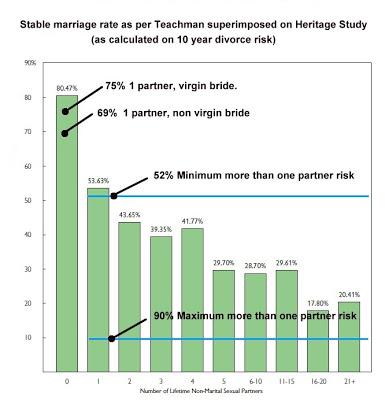
Another aspect of hypergamy today is the tendency for women to pursue men far above her “marriage marketplace value.” It is not hard for an average woman (5/10 to 7/10; we will exclude the Fuglies below 5/10) to have sex with a well-above-average, or let’s say Top 10% man. But, the Top 10% Man can have sex with 80% of the women only if they do not commit to any one woman. In other words, if a Top 10% man is available (not already in a marriage or long-term commitment), it is because he will absolutely never, never marry you, or even engage in an “exclusive” relationship of some sort. For a woman, this Hypergamy, in the form of a woman’s desire to have sex with and form a committed relationship with a Top 10% man, will result in a pattern of being repeatedly dumped, or “cheated on.” In other words, it will produce a pattern not of becoming a Wife, or even a Girlfriend (monogamous relationship with emotional commitment), but Friends With Benefits at best. Since this is inherently unstable and short-term, the woman soon ends up with a string of such relationships. In the past, this outcome was prevented by the practice of not having sex before marriage. On a lesser scale, but common in the past, it was prevented by the practice of developing a sort of committed (monogamous) boyfriend/girlfriend relationship first (aka “love”), to which sex is added some considerable time later.
Sexual Utopia in Power, by Roger Devlin, was a paper published in the Occidental Quarterly. Published in 2006, it is still perhaps the best single expression of the “red pill” today. Reportedly, it is the origin of the word “hypergamy.” I offer this particularly to women, as an introduction of the analytical principles which have led me and many other men to our conclusions today, which are: doing things the way they were done in 1900 is a good idea. This is: Courtship, not “dating”; get married young (ideally 18-20); be a housewife; have children young, and plenty of them. You can do all that career stuff later, when your children are out of the house.
Although this is considered basic stuff today, I would also assert that this shows why men have the responsibility of identifying these problems, and fixing them. In other words, Matriarchy Does Not Exist. Women are still confused that 80% of the women can’t marry 10% of the men. This riddle has stumped them for the last fifty years, and it will continue to stump them forever (unless men tell them the answer).
I have been reading Charles Darwin’s The Voyage of the Beagle. In the 1830s, Darwin spent nearly five years aboard the Beagle, which conducted a variety of scientific/geographical surveys mostly of Argentina and Chile. After this main task, they traveled to Australia, New Zealand and the South Pacific, before heading back to London.
This ship was crewed, naturally, entirely by men. A group of men spent five years together, with no women. When Darwin was ashore, he was also engaged in studies that mostly consisted of difficult overland travel, with no women. They struggled up rivers, crawled through the forests of Tierra Del Fuego, and crossed deserts populated primarily by bandits. Since this was Charles Darwin, he was also engaged in an intellectual adventure. He collected many samples of flora and fauna, and engaged in countless studies of geology. This led to his own theories of speciation, and also some interesting studies on the origin of atolls, the geological history of these regions, and other interesting subjects.
It was, in short, a wonderful adventure. This is a man’s idea of adventure: going off, in the company of other men, to discover something interesting.
Women like adventure too. But, a woman’s idea of adventure is, in the first instance, sexual adventure; and, in the second instance, in the company of men, primarily her husband. For example, a woman today might also daydream of spending five years aboard the Beagle, in the company of the young Charles Darwin and a hundred other men whose hard, tanned bodies have been tempered by the physical toil of life on the sea. Hubba hubba. But, do you ever find a woman who daydreams of spending five years on a ship with a hundred other women, and no men? This never happens. It also never happens in real life. In real life, perhaps in the entire history of humanity, a hundred women have never set off on a five-year sailing adventure, with no men on board, and where they could not expect to ever meet a man.
In the second instance, a woman’s adventure is not quite sexual adventure, but it takes place alongside men, primarily her husband. Many women joined their husbands to explore and populate new and remote areas, raising children along the way. It is practically the whole history of America from the seventeenth century to about 1920. Today, women can take adventurous paths, for example becoming a Hollywood actress or starting a business. But, most adventure for women today is sexual adventure: a string of exciting bad boys. She imagines that home and family is the end of adventure, and the beginning of drudgery and toil.
Women, although naturally somewhat cautious, also like to have a share of adventure. The problem with sexual adventure is that it doesn’t end well: a woman ends up a worn-out slut incapable of forming a stable relationship. Even if she manages to get married (which she usually does), she will then tear apart her own family and end up as before, a single woman in search of sexual adventure. And then, there is still another forty years to get through. Also, sexual adventure normally requires a woman to be a single, working woman. Most employment is drudgery and toil; a housewife has far more sovereignity and freedom to do as she likes. In the past, this adventure was commonly alongside a husband. A husband and wife, together, would do something adventurous.
Unfortunately, I think that most men today are not very adventurous. They have had to temper their natural sense of adventure to succeed within the constraints of school and corporate work. Women find them boring. They do not hold out much promise of adventure together.
I do not think it is necessary to take long sailing voyages to be adventurous. You can simply think adventurous thoughts. Most men today are terrified at the idea of thinking thoughts that are deviant from what they are being told to do by the media or their school teachers. They are terrified at wearing any kind of interesting clothing, or driving an adventurous car, or doing any sort of interesting thing — of being a creative force in the world. I sometimes wonder what women think of the typical successful men of the professional class. These would seem to be some of the most desirable men around. They make high incomes, and have positions of responsibility and expertise. From a man’s point of view, they are often quite impressive. They do a difficult job well, and are reliable, trustworthy and cooperative. From a woman’s point of view, I think most of them seem like pasty, out-of-shape lumps with a pathological attachment to khaki pants and denim shirts. An office of these men gives the impression of a koala bear farm. They do not have an energy of adventurousness, even though they may actually be involved in something quite adventurous.
Earlier, I mentioned the example of Steve Cohen, one of the top hedge fund managers of the past thirty years:
Not only is hedge fund management inherently adventurous, but Cohen also built a huge organization, became one of the top funds in the industry, and became a billionaire along the way. From a man’s point of view, a very impressive guy. Very very. But, if I didn’t tell you all that, and said only that he was a successful professional in the financial industry in New York, and worked long hours in the office, I can see how a woman might not be very turned on by this prospect. It seems dull. She would rather hang out with some rock band drummer.
Earlier, I mentioned that Cohen participated in a video dating service — he probably omitted some of the details to weed out the gold diggers — and contacted twenty-seven women. Only one responded, a single mother who grew up in public housing. They got married, and apparently, she has been a very good wife. Good for them.
Here is another successful professional who spends long hours in the office in New York:
While this is a particularly good looking actor, nevertheless I think that, on top of that, he expresses a possibility of “adventure,” from a woman’s point of view. But, this is rare today. So, when I suggest that the proper sphere for adventure for a woman is alongside her husband, I can understand why women might look at this prospect with a little skepticism.
I have been suggesting that a woman today should get married around age 18-20, and launch right into the big adult responsibilities of raising children and managing a household. One reason for this is that, a woman waits until age 28 to marry, then the ten years in between will typically be occupied either with celibacy, sexual adventure, or a near-marriage with the man that she will eventually marry, or perhaps not marry — four bad options. But women nevertheless cling to this pattern, in part from their desire for adventure.
So, I will suggest that marriage can also be a forum for adventure, for a woman. Even if a woman gets married at 18, she might delay having children until perhaps age 23, and spend those five years traveling and doing fun things, with her husband — just as women do with their boyfriends today. Her husband may be involved in something adventurous — starting a new business for example, or moving to a new city — that she takes part in alongside. Even if her husband is, to some degree, a boring provider, she would likely have plenty of flexibility to do something interesting during the day. Just having children is an adventure. This is particularly true now, when the whole process of motherhood and family must be hewn out of raw materials. We cannot do what others have done in the past, and are doing today. There lies only degeneracy and failure.
Or, as Jack summarized well in the comments below: “Getting married, joining her husband in his life mission, and having a family should be a woman’s greatest adventure in life. Unfortunately, there’s too much propaganda telling women the opposite.”
In short, we should reconcile the conflict that is felt by women between being married at 18, and having a bit of adventure. People did it in the past. Caroline Ingalls, of Little House on the Prairie, was very adventurous. Mostly, it is a matter of just doing it — doing something adventurous, within the context of marriage and family.



 Cornerstone